
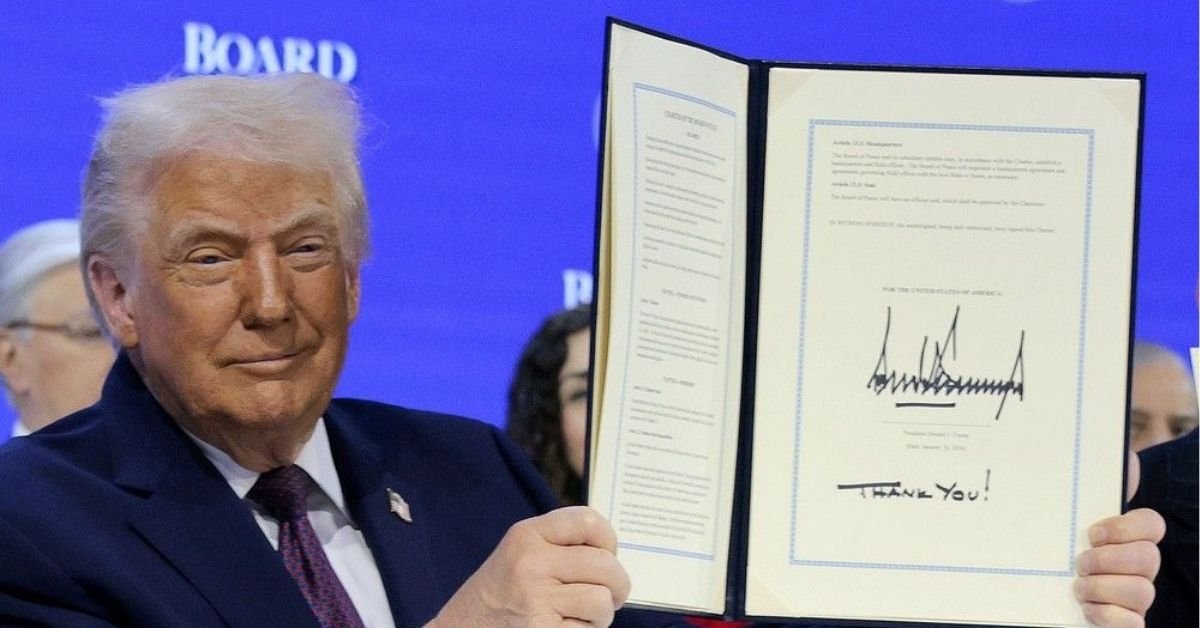
In response to the Israel-Gaza war USA president Donald Trump announced his plans to organise a Board of Peace.
What is the Board of Peace?
The board was first announced on 29 September 2025 when it was initially proposed. It was then later formally announced as formed on 15 January 2026 by U.S. President Donald Trump as part of a new international peace initiative tied to the Gaza peace process. The board will be dedicated to resolving international conflicts and promoting stability, in a signing ceremony on the sidelines of the World Economic Forum in Davos.
The board, first proposed by Trump as part of his peace plan tied to the Israel-Hamas war in Gaza, was officially established this week at Davos with the signing of its founding charter. The announcement was made on Wednesday evening with an optional membership buy-in of $1 bn.
The launch was done in a signing ceremony in Davos, Switzerland with countries such as the UAE, Albania, Armenia, Azerbaijan, Belarus, Hungary, Kazakhstan, Morocco and Vietnam already showing interest. The new board was described by Trump as a new mechanism for peacebuilding and conflict resolution.
“It is my great honour to announce the Board of Peace,” President Trump said at the event, which drew leaders and representatives from a number of countries. About 35 nations have committed to joining the board, U.S. officials said, although invitations were extended to around 50 states.
The board’s charter gives it a broad mandate to work on international peace issues. It sets out three-year membership terms, with permanent seats available to states that contribute $1 billion. President Trump will serve as chairman and U.S. representative under the charter. Although the buy-in guarantees permanent membership, President Trump still retains significant power over the direction of the board.
Thoughts on The Board of Peace Establishment
The European External Action Service, the European Union’s diplomatic corps, expressed worries about a concentration of power in President Trump’s hands, stating that the new board charter raises concern under EU’s constitutional principles. Several EU countries, including France and Spain, have already said they would not be joining the board.
Supporters say the board could help advance diplomatic solutions where traditional institutions struggle, with an initial focus on maintaining a cease-fire in Gaza and supporting reconstruction efforts following Israel’s two-year conflict with Hamas.
However, some major world powers have not joined the board, and observers note that key Western allies have stayed away from the signing ceremony. Some argue the body could rival or undermine the United Nations, whose members include most global governments and whose authority has long anchored international diplomacy.
President Trump defended the initiative, saying the board would work “in conjunction with the United Nations”.
The board’s charter does not explicitly limit its activities to Gaza, suggesting a wider scope for engagement in global peace efforts. The broad mandate, along with the hefty financial threshold for permanent membership, has drawn both interest and scepticism from prospective member states.
Which Countries Have Rejected and Accepted the Invitation So Far?
Representatives from Middle Eastern and African countries, including Israel, Saudi Arabia, the United Arab Emirates, Bahrain, Jordan, Qatar, and Egypt. NATO member Turkiye, were among those present at the ceremony. Participation by European powers and other traditional U.S. allies was notably limited, a reflection of mixed global reactions to the initiative.As of now, 60 countries have been invited but countries like Sweden and some other European countries rejected the invitation.
Norway was initially invited but their invitation was later withdrawn, after President Trump accused the President of Norway of not giving him a Nobel Peace Price.
Canada expressed its interest but stated it will be foregoing the $1billion payment. Russia, Ukraine, China and the executive arm of the European Union have not yet indicated their response to Trump’s invitations as they are still reviewing the charter.
Conclusion
This new board might not seem like much at first, but if it remains in power, it has the potential to challenge the authority of the United Nations. This growing concentration of power in Trump’s hands could lead to further repercussions down the line. What do you think, does this board truly have what it takes to unseat the UN, or is it bound to fail in the long run?
TheJour.com will continue to follow developments on the Board of Peace and report new updates.