

LFor a country confronting complex and evolving security challenges, the ability to produce a significant portion of its own defence requirements is a strategic necessity.
Nigeria’s security environment demands that the Armed Forces have reliable and sustained access to equipment, ammunition, spare parts, specialised systems and the technical expertise required to maintain and adapt them. Excessive dependence on foreign sources can expose national defence planning to supply disruptions, lengthy procurement cycles, external restrictions and changing geopolitical circumstances.
This is why the drive towards indigenous defence production must be understood as an issue of national security.
It is against this backdrop that the recent two-day strategic visit to Egypt by the Minister of State for Defence, Dr. Bello Mohammed Matawalle, MON, assumes particular significance.
Leading a high-level Nigerian defence delegation comprising representatives of the Ministry of Defence, Defence Headquarters, the Nigerian Army, Nigerian Navy, Nigerian Air Force, Office of the National Security Adviser, Defence Intelligence Agency and the Defence Industries Corporation of Nigeria (DICON), Matawalle’s mission was about examining how Nigeria can build the capacity to produce more of what it needs at home.
For decades, Nigeria, like many developing countries, has relied substantially on foreign suppliers for military hardware and other critical defence requirements. While international defence partnerships will remain important, sustainable national security requires Nigeria to progressively move from being predominantly a consumer of defence technology to a producer and co-developer of defence capabilities.
The Egyptian visit offers a practical pathway towards that transition.
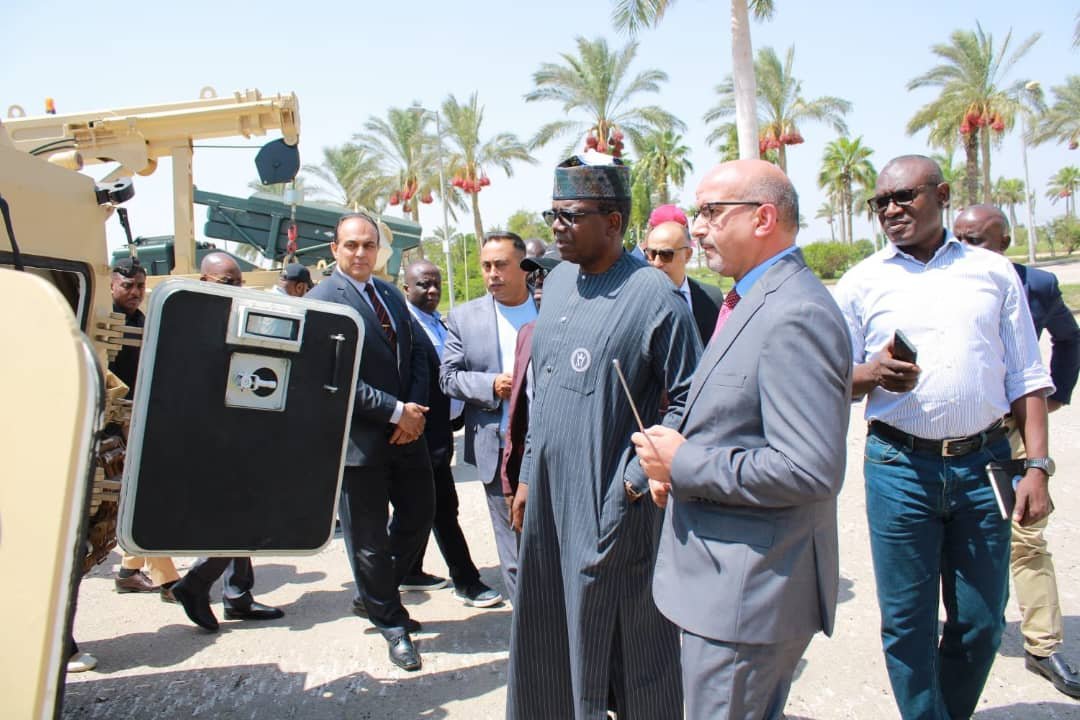
At the manufacturing facilities of Eagle International for Defence Systems Company in Suez, the Nigerian delegation examined defence systems and industrial processes, gaining first-hand exposure to Egypt’s expanding domestic defence manufacturing ecosystem.
The significance lies not simply in what Nigeria can procure from Egypt, but in what Nigeria can learn, adapt and eventually manufacture domestically.
Matawalle made this position clear, emphasising that the mission was strategic and developmental rather than centred on immediate procurement. The objective is to explore sustainable industrial partnerships, particularly through DICON, that could facilitate the joint manufacture of selected military equipment and systems in Nigeria.
Such an approach changes the character of defence cooperation.
Instead of a transaction in which Nigeria pays for finished products, an industrial partnership can create opportunities for Nigerian engineers, technicians and institutions to participate in production; for local suppliers to enter defence value chains; for technical knowledge to be transferred; and for Nigerian facilities to progressively acquire the capability to manufacture, maintain and improve critical systems.
Perhaps the most consequential outcome of the visit was the engagement with Egypt’s Ministry of Military Production in Cairo, where discussions focused on the possibility of establishing an ammunition production line in Nigeria through structured technical and industrial cooperation.
This is precisely the kind of capability that can transform Nigeria’s defence posture.
A military’s operational effectiveness is inseparable from the reliability of its ammunition supply. Domestic production can provide greater control over supply chains, reduce vulnerabilities associated with external sourcing and enable the Armed Forces to maintain more predictable stocks for sustained operations.
It also has a wider industrial significance. An ammunition production capability requires expertise in engineering, metallurgy, chemicals, precision manufacturing, quality assurance, testing, safety and industrial management. Building such capabilities therefore strengthens the broader technological ecosystem on which a modern defence industry depends.
The proposed Egyptian-Nigerian cooperation could consequently, if properly structured, contribute to the development of a larger Nigerian defence manufacturing ecosystem.
Defence self-reliance should not be mistaken for a country attempting isolation. Nigeria will continue to require strategic partnerships with countries possessing more advanced technologies and mature defence industries. Indeed, technology transfer and joint production are among the most effective ways for Nigeria to accelerate its own industrial development.
The objective is to ensure that these partnerships progressively build Nigerian capacity.
A self-reliant defence industry offers several strategic advantages. First, it strengthens national security. Nigeria becomes less vulnerable to disruptions in international supply chains or circumstances that could affect access to critical equipment. Second, it improves operational sustainability. Local production and maintenance capabilities can reduce dependence on lengthy overseas procurement and servicing processes.
Third, it develops national technological capacity. Defence manufacturing is technologically demanding and can drive advances in engineering, electronics, materials science, precision manufacturing and other fields with applications far beyond the military.
Fourth, it creates jobs and industrial opportunities. A functioning defence industry can stimulate local manufacturing, research and development, technical training and private-sector participation.
Finally, it strengthens Nigeria’s strategic autonomy. A country that can increasingly design, manufacture, maintain and upgrade its own critical defence systems has greater freedom to pursue its national security interests.
The job Dr. Matawalle is doing is particularly important. He is helping to place defence industrialisation at the centre of Nigeria’s security strategy.
His approach, reflected in the Egyptian mission, is centred on identifying capable international partners, creating channels for technology and knowledge transfer, and translating diplomatic relationships into concrete industrial capabilities for Nigeria.
The composition of the delegation was itself significant. Bringing together the Ministry of Defence, the Armed Forces, intelligence institutions and DICON underscores that crucial thinking that our indigenous defence production cannot be developed by a single institution. It requires the alignment of military requirements, intelligence considerations, industrial capability, technical expertise and national security priorities.
The larger objective of the Minister is to help build the industrial infrastructure that can support Nigeria’s defence requirements tomorrow.
At the heart of this effort is DICON, which is increasingly becoming an important anchor of Nigeria’s defence manufacturing ambitions. The partnership being explored with Egypt provides an opportunity to strengthen DICON’s technical and industrial capabilities through exposure to established production systems and structured cooperation.
Egypt has progressively developed a defence production ecosystem capable of manufacturing a broad range of military equipment and systems. Nigeria does not need to replicate Egypt wholesale. It can learn from the country’s experience and adapt relevant models to its own security requirements, industrial base and economic circumstances.
The discussions in Cairo and the tour in Suez should be viewed as the beginning of a potentially consequential industrial partnership.
The next challenge is implementation: translating the areas of agreement into formal frameworks, defining technology-transfer arrangements, establishing production timelines, developing Nigerian technical capacity and ensuring that projects deliver meaningful local content.
If successfully executed, the proposed cooperation could mark an important shift in Nigeria’s defence philosophy—from buying capability abroad to building capability at home. That is ultimately the larger significance of Dr. Matawalle’s Egypt mission.
– Dahiru Bashir Hassan is a defence and security researcher and writes from the FCT