

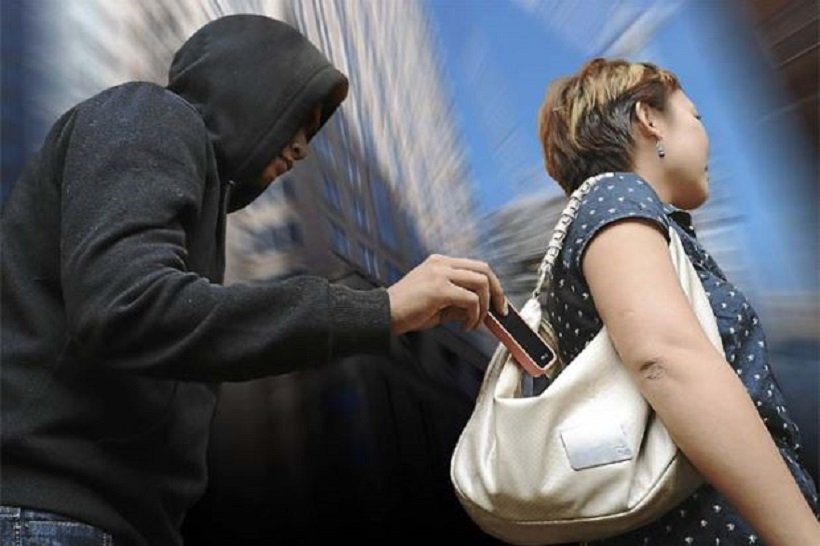
Between May 2023 and April 2024, Nigerians experienced an estimated 25.35 million incidents of phone theft. Broken down, that is roughly 2.1 million a month, about 69,000 a day and nearly 2,900 an hour. Close to one phone every second. At that rate, in the time it takes to read this paragraph, around ten more phones will have been stolen.
The estimate comes from the National Bureau of Statistics, whose survey also found that the incident count was higher than the number of victims, which tells us that some Nigerians have experienced phone theft more than once. At this scale, it is not an occasional street-crime problem. It is a mass consumer-security problem occurring at extraordinary scale.
The numbers are remarkable. More remarkable still is how ordinary the crime has become, and how readily we have learned to live with it. We have developed an entire set of habits around the possibility of losing a phone. Do not hold it too close to the window in traffic. Be careful taking calls when walking at night. Keep it out of sight in certain places. If it is stolen, block the SIM, contact the bank, change passwords and secure or freeze affected accounts.
We have become effective at telling victims what to do after the fact. That very competence should give us pause. Why has a crime on this scale been treated, for so long, as something for individuals to manage on their own? Personal caution matters, but a problem this large cannot be solved by telling citizens to hold their phones more tightly.
A phone used to be just a piece of equipment. Today, it can be the entrance to a person’s financial and digital life. It holds conversations, photographs, work documents and contacts. It can provide access to email, social media, banking applications and payment platforms. For traders and small business owners, it may also be a shopfront, customer database and payment terminal. The immediate financial loss is therefore only part of the harm. A stolen device can create a second crisis as its owner races to secure bank accounts, email addresses and other services before the thief gains access.
But the next question is not just what the victim loses. It is what the thief gains. What happens to the millions of stolen phones after they are taken?
They are resold. They are reactivated. They move between networks, between cities, sometimes across borders. Some eventually return to the market as apparently legitimate second-hand devices. There have been reported cases of Nigerians discovering, during repairs or trade-ins abroad, that phones purchased at home had previously been reported stolen in Europe. In such cases, an innocent buyer may lose both the device and the money paid for it. Phone theft persists at this scale for a plain economic reason: a stolen phone continues to hold value after it has been taken. As long as there is a ready market through which stolen devices can return to circulation, the crime remains profitable.
Compare that with other stolen things. A stolen bank card can be cancelled in minutes. A stolen passport can be invalidated. A stolen car encounters systems of registration and identification designed to make lawful transfer more difficult. In each case, legitimate systems work to limit the stolen item’s usefulness. The principle is simple and well established: make the stolen thing worth less, and you make the theft less worthwhile.
In this market, phones do not follow the same logic. Where its device identifier has not been reported and effectively blocked, a stolen handset may return to service with a different SIM as though nothing had happened. Yet the technology to treat it differently already exists. Every mobile phone is assigned an International Mobile Equipment Identity, or IMEI—a 15-digit identifier distinct from the SIM. Put simply, the SIM identifies the subscription, while the IMEI identifies the device. This allows a network to recognise a handset even when the SIM changes, although identifiers can sometimes be cloned or tampered with.
This is not a new conversation. Phone theft is a global problem, and several countries have developed systems that respond through the identity of the device itself. India, for example, operates a national register that enables phones reported stolen to be blocked across participating mobile networks. By linking the victim’s report, the device’s identity and the wider mobile ecosystem, the system makes it far harder for a stolen handset to return to network service simply by changing the SIM. Brazil links a stolen-phone report to broader protective action across mobile networks and participating financial institutions, helping to reduce the risk of the financial fraud that can follow. Internationally, a shared industry database also allows lost and stolen device identifiers to be recognised by participating operators across borders.
The principle is clear: By reducing the usefulness and potential resale value of stolen devices, these systems are designed to reduce the incentive to steal them. Policing, prosecution, public awareness and personal vigilance all remain essential, and none of them should be diminished. But these interventions largely focus on punishing the crime or limiting the damage afterwards. What they do not directly address is the value of the stolen device itself, the thing that helps make the crime profitable.
So what would it take for Nigeria to move from managing the consequences of phone theft to undermining the market that sustains it?
More than 25 million incidents in a single year should push that question much higher up the public agenda. Phone theft is at once a street-crime problem, a telecommunications problem, a consumer-protection problem, a financial-security problem and, when stolen devices cross borders, an illicit-market problem. It deserves a response equal to that complexity.
A country losing phones at close to one every second cannot rely indefinitely on victim vigilance and after-the-fact damage control. If the useful life of a phone can be interrupted once its lawful owner reports it stolen, the economics begin to change. The next frontier is to make stolen devices harder to use, harder to sell and, ultimately, less worth stealing.
– Yunus Ahmed is a technology enthusiast and writes from Abuja (yunusxonline@hotmail.com)