
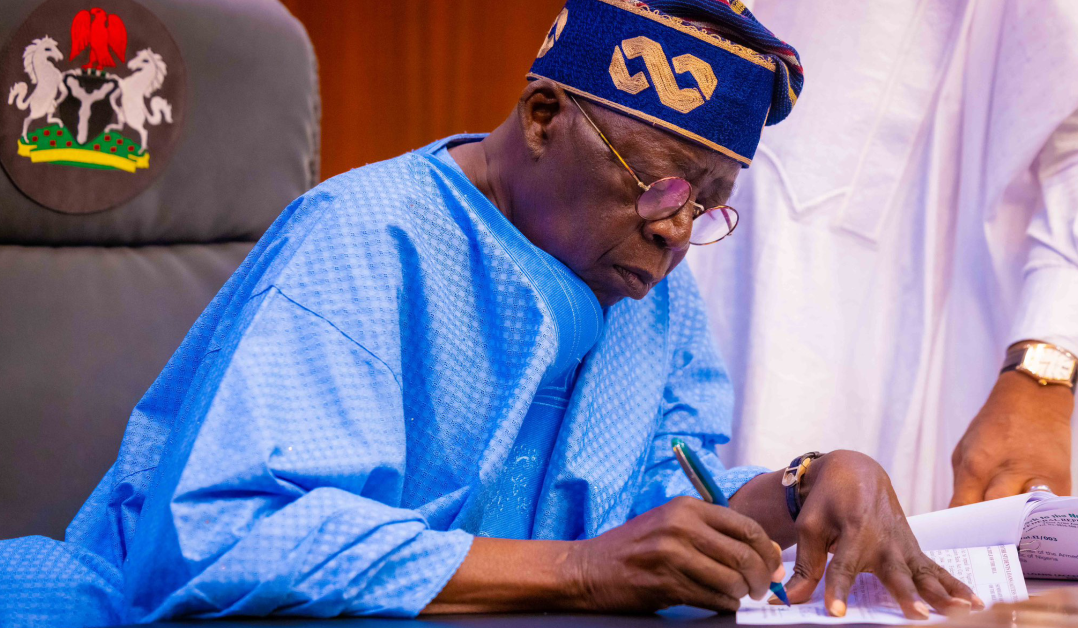
After weeks of intense deliberations and sharp divisions within the National Assembly, President Bola Tinubu on Wednesday signed the amended Electoral Act into law, sealing one of the most hotly debated legislative reforms ahead of the next general election.
The amendments to the 2022 Electoral Act sparked controversy in both chambers, particularly over provisions relating to electronic transmission of results and the extent of technological integration in the voting process. While some lawmakers pushed for stronger digital guarantees, others raised concerns about infrastructure gaps and system vulnerabilities.
Despite the stormy debate, the bill secured passage and was forwarded to the President for assent.
Speaking at the signing ceremony, Tinubu acknowledged the contentious nature of the process but framed it as a healthy reflection of democratic engagement.
“The essence of democracy is to have very solid brainstorming discussions committed to national development, nation-building, and the stability of the nation,” he said, adding that robust debate ultimately strengthens institutions.
The President emphasised that Nigeria’s voting process remains fundamentally manual. According to him, voters still cast ballots physically at polling units, and results are counted by hand before figures are entered into the system.
“As long as you appear personally as a manual voter in any polling booth, a ballot paper is given to you manually. You decide in a corner, fingerprint the person you choose, and cast your vote without hindrance,” Tinubu stated.
He noted that the real controversy centred on the transmission of results, warning against over-reliance on technology without addressing broadband capacity and cybersecurity risks.
“When you look at the crux of various arguments, maybe Nigerians should question our broadband capability. How technically sound are we today? How technically sound will we be tomorrow?” he asked, stressing the need to prevent glitches, interference and hacking.
In his remarks, Senate President Godswill Akpabio admitted that not all lawmakers agreed with the final provisions but described the eventual consensus as the “beauty of democracy.”
He revealed that the National Assembly worked on the amendments for nearly two years to ensure that the Independent National Electoral Commission has adequate time to make procurements and release a timetable for next year’s elections.
Akpabio added that the revised law strengthens provisions for electronic transmission of results and reinforces the INEC Result Viewing (IReV) portal, which allows citizens to monitor polling unit outcomes nationwide.
Also present at the ceremony were Speaker of the House of Representatives Tajudeen Abbas, Deputy Speaker Benjamin Kalu, Chief of Staff to the President Femi Gbajabiamila, and Special Adviser to the President on Senate Matters Basheer Lado, among other principal officers.
With Tinubu’s signature, the amended Electoral Act now becomes the legal framework for the forthcoming elections, even as debates over infrastructure readiness, cybersecurity safeguards and electoral transparency continue to shape political discourse nationwide.