

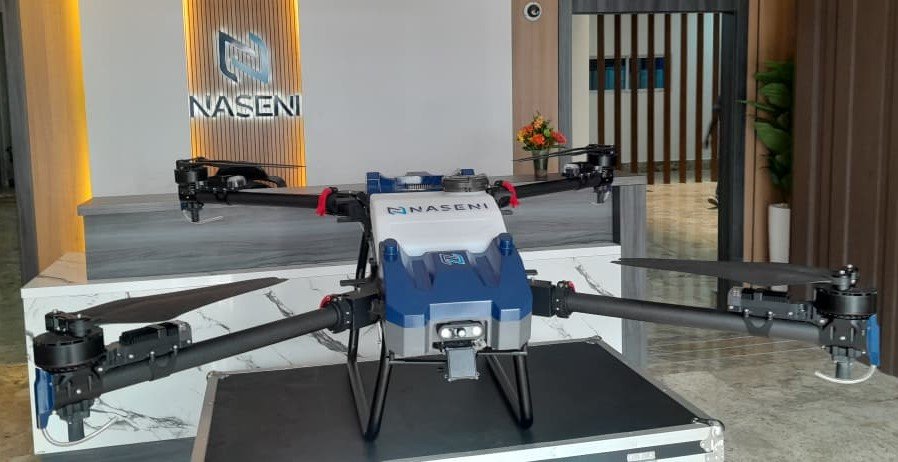
The National Agency for Science and Engineering Infrastructure (NASENI) has assembled more than 2,500 drones in Nigeria through one of its industrial partnerships, its Executive Vice Chairman/Chief Executive Officer, Khalil Suleiman Halilu, has disclosed.
Halilu, speaking during an exclusive interview on the Nativeland Podcast, said the drones were assembled under a partnership involving NASENI, as he defended the agency’s emphasis on local assembly as an important step in Nigeria’s industrialisation drive.
“We have nothing less than 2,500 drones on ground, all assembled,” Halilu said, adding that women participating in some of NASENI’s engineering programmes were involved in the initiative.
The NASENI boss said the agency was deliberately developing an industrial ecosystem that allows Nigerians to move from innovation and prototyping to commercial-scale production.
According to him, one of the major gaps confronting Nigerian innovators is not necessarily the ability to develop prototypes, but the capacity to transform successful prototypes into products that can be manufactured at scale.
“There are a lot of creatives in Nigeria building solutions,” Halilu said. “But it is one thing to build a single car… It is another thing to replicate it into hundreds and mass-produce it.”
He said NASENI was attempting to close this gap through its innovation hubs and network of about 12 institutes specialising in different areas of science and engineering, including agriculture and hydraulics.
The objective, he explained, is to ensure that innovators can access support throughout the journey from developing an idea and building a prototype to establishing commercially viable industries.
NASENI’s innovation hubs also provide entrepreneurs with skills outside their core technical disciplines, including marketing, accounting and cash-flow management.
“You can’t just be an engineer or a scientist,” Halilu said. “If you want to scale your products, you need some entrepreneurial skills.”
He said the agency was similarly expanding opportunities for women to participate in engineering and industrial production, including programmes supporting women developing mechanised agricultural equipment and other technologies.
Rather than prescribing specific technologies that participants must develop, Halilu said NASENI’s approach was to create an enabling pathway through which their creativity could thrive and their confidence to participate in engineering could grow.
The agency is also involved in renewable-energy manufacturing. Halilu said NASENI Solar Limited produces solar panels at its facility in Karshi, near Abuja, with NASENI solar pumps also being deployed.
‘Assembly is actually production’
Halilu also pushed back against criticism that Nigeria’s industrialisation strategy should move immediately from assembling imported components to manufacturing products entirely from scratch.
“Assembly is actually not a bad thing,” he said. “In the world of globalisation, you need to know where you play. Otherwise, you produce something and sell it at a loss.”
He argued that modern manufacturing is built around global supply chains in which countries specialise according to their comparative advantages rather than attempting to manufacture every component of a product domestically.
For Nigeria, Halilu identified competitive labour costs and the country’s large population as advantages that could support its emergence as an assembly and manufacturing hub.
“If you hire a person from Germany, his salary will probably, for the same role, hire maybe 10 or more Nigerians,” he said.
He argued that Nigeria could even compete favourably with established manufacturing locations such as China on labour costs, provided the country clearly identifies where it can compete within global production chains.
“Every country is playing its own role in the production chain,” Halilu said. “You need to understand what you bring to the table that you are competitive at, [that] other people can’t offer.”
He pointed to the international technology industry to illustrate his argument, noting that major global technology companies frequently design products and own their intellectual property in one country while sourcing components and assembling the final products elsewhere.
Halilu said Nigeria should adopt a similarly pragmatic approach rather than measure industrialisation solely by whether every component of a product is manufactured domestically.
He compared industrial specialisation to building a football team, where individual players are selected for positions in which they possess the greatest advantage rather than attempting to perform every role.
The priority for Nigeria, he argued, should therefore be to identify the segments of global manufacturing where the country possesses genuine competitive advantages and build the skills, infrastructure and industrial capacity required to dominate those areas.
For NASENI, that strategy means creating an industrial pipeline that begins with encouraging young Nigerians to embrace science and engineering, supports innovators through prototyping and commercialisation, and ultimately connects viable technologies to factories capable of producing them at scale.