
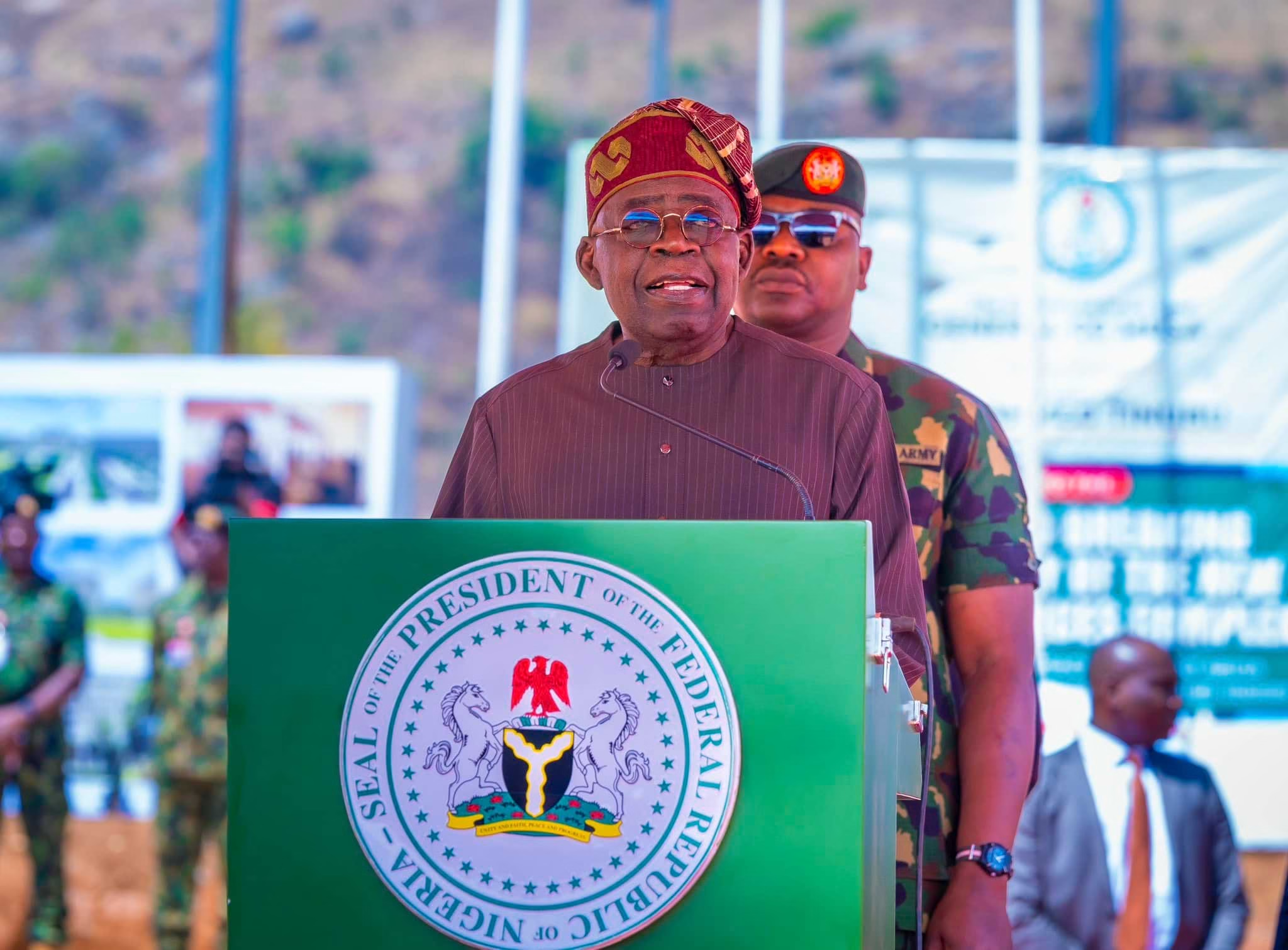
President Bola Ahmed Tinubu used Nigeria’s 66th Independence Day address to declare a shift in the focus of his administration, from correcting economic distortions to delivering broader prosperity, jobs and improved living standards.
Speaking under the theme “From Reforms to Prosperity,” Tinubu defended the difficult economic measures implemented since 2023, while acknowledging the pressures they have placed on households and businesses.
The President said the next phase must focus on translating economic reforms and improved macroeconomic conditions into tangible benefits for Nigerians.
Here are five key things to know about the address.
1. Tinubu says the reform phase has given way to prosperity
One of the clearest messages in the speech was that the administration believes the most difficult phase of its economic adjustment programme has been completed.
Tinubu described the reforms as necessary treatment for deep-rooted economic problems that had accumulated over decades.
“The emergency treatment is over. The foundation has been repaired,” he said.
The President argued that the government’s central economic task has therefore changed. After three years focused primarily on correcting the country’s economic direction, he said the priority must now be “shared and widespread prosperity.”
That means the administration’s economic performance will increasingly be judged not only by macroeconomic indicators, but by whether Nigerians experience improvements in production, employment, income and living standards.
2. Lowering the cost of living is now a central priority
Tinubu placed the cost of living at the heart of the next phase of his economic agenda.
His approach is to reduce the cost of producing and moving goods rather than relying only on measures that address prices after they have risen.
He pointed to mechanised farming, irrigation, improved access to seeds and fertiliser, storage facilities, roads, railways and ports as important parts of the strategy.
The President’s argument is straightforward: if farmers can produce at lower cost, fewer agricultural products are lost, manufacturers have more reliable power and goods can move more efficiently, some of those savings should eventually be reflected in market prices.
The approach puts productivity and supply-side improvements at the centre of the government’s response to the cost-of-living challenge.
3. Jobs, industry and production are moving to the centre of the agenda
Another major theme of the speech was the need to turn Nigeria’s large young population into a source of economic production.
Tinubu said jobs, enterprise and industrial growth would be at the heart of government policy, with plans to use gas to support industries, revive factories, expand digital connectivity and provide businesses with infrastructure and financing.
He also spoke of a Nigeria where more farmers supply domestic industries, more businesses manufacture for export and young Nigerians build technology companies and create employment.
The emphasis is significant because the President linked prosperity to productive work, rather than economic growth alone.
The challenge for the next phase will be converting investment, infrastructure and economic expansion into millions of sustainable productive opportunities.
4. Tinubu used economic indicators to defend the direction of his reforms
A significant portion of the address was devoted to evidence the President said demonstrates an improvement in Nigeria’s economic outlook.
Tinubu said the economy had grown by more than 4 per cent in 2026, with both the oil and non-oil sectors contributing to growth.
He also cited a substantial decline in inflation from its peak, rebuilt foreign reserves, greater stability in the foreign exchange market and a record $6 billion-plus in non-oil export revenue in 2025.
The President further said oil theft had declined and foreign direct investment was rising.
These figures were presented as evidence that the reforms are beginning to strengthen the foundations of the economy. Their broader significance, however, will ultimately depend on how sustained these trends prove to be and how effectively they translate into improved conditions for households and businesses.
5. The “Red Sea” metaphor captures the administration’s new economic narrative
The most striking rhetorical moment of the address came near its conclusion, when Tinubu described Nigeria’s economic journey in biblical terms.
“Nigeria has corrected its course. We have passed through our own Red Sea,” he said.
The metaphor presents the difficult reform period as a journey through economic hardship towards a more prosperous destination.
Tinubu’s description of that destination was not limited to stronger economic statistics. He spoke of farmers producing safely and profitably, factories operating with reliable power, businesses accessing credit, young people finding productive work and families having greater confidence in the future.
He described this as the “Promised Land” of a Nigeria where prosperity is broadly shared.
The message was also a call against reversing the policies introduced during the reform period.
“This is not the time to look back,” the President said.
The bigger message
Tinubu’s Independence Day address was ultimately a transition from one phase of his economic agenda to another.
The first phase, as presented by the President, was about correcting economic distortions and restoring stability. The next phase is about turning that foundation into lower production costs, stronger businesses, more jobs and broader prosperity.
That transition also raises a new set of expectations.
For Nigerians, the most important measure of the “age of prosperity” will not be economic terminology or headline indicators alone, but whether reforms increasingly translate into affordable goods, productive employment, stronger household incomes, reliable infrastructure and greater opportunities.
Tinubu ended his address with a simple message that captured the direction he wants his administration to take:
“Our destination is in sight. Our foundations are strong. Our direction is clear. So let us go forward. No looking back.”