
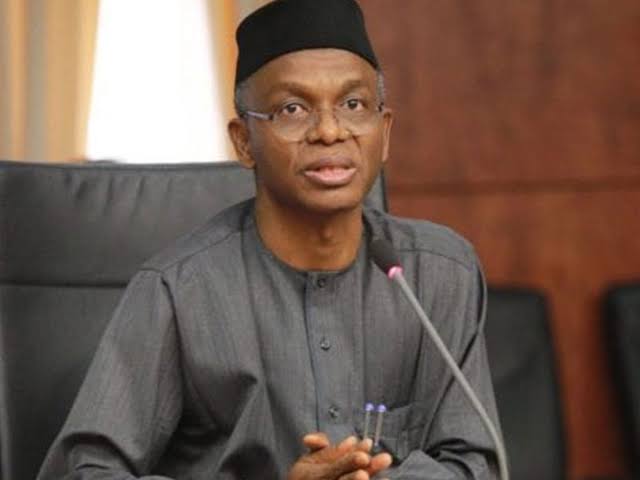
Former Kaduna State Governor Nasir El-Rufai has denied allegations that he and some of his associates earmarked $600,000 to bribe officials of the Economic and Financial Crimes Commission (EFCC) and intermediaries.
The allegation was made Tuesday by Segun Kayode, a forensic investigator with the Department of State Services (DSS). Kayode, the first prosecution witness in the ongoing trial, made the allegation while testifying before Justice Darius Khobo at the Kaduna State High Court in Kawo, Kaduna.
The investigator told the court that the alleged payments comprised $500,000 and $100,000. He added that forensic audio recordings captured conversations involving El-Rufai and some of his suspected associates.
According to Kayode, the conversations centred on alleged attempts to frustrate an EFCC investigation into a company identified as Singularity.
He named Senior Advocate of Nigeria (SAN) A.U. Mustapha, Jimi Lawal and Bashir El-Rufai among those allegedly mentioned in the recordings.
Kayode further alleged that Mustapha and Lawal were directed to meet Ahmadu Sule to obtain a template previously used to liquidate another company in Nigeria and Mauritius, where the Nigerian Financial Intelligence Unit was reportedly investigating it, with the intention of applying a similar process to Singularity.
The allegations form part of the prosecution’s evidence against the former governor and have yet to be established in court.
Earlier, El-Rufai’s lead counsel, Paul Erokoro (SAN), objected to Kayode’s testimony, arguing that the prosecution had not included the witness’s name and summary of evidence in its proof of evidence.
Erokoro said the omission undermined his client’s right to a fair hearing, insisting that the defence needed to know the evidence it was expected to answer.
However, Adedipe said the court issued and signed the subpoena on June 30, 2026, adding that the defence would have the opportunity to cross-examine the witness. He also cited judicial authorities to support his position.
In response, Erokoro maintained that the issue was not whether Kayode could testify but whether the defence had received adequate notice to prepare for his evidence.
He cited Section 210 of the applicable Administration of Criminal Justice Law, 2017, and argued that the prosecution should have served the subpoena on the defence.
In its ruling, the court acknowledged that Kayode’s name and summary of evidence were absent from the proof of evidence. However, Justice Khobo held that the records showed the court had subpoenaed the witness.
The court adjourned the case until Nov. 30 and Dec. 1, 2026, for the continuation of cross-examination after both parties agreed to the dates.
The former governor faces multiple cases involving allegations of money laundering, abuse of office, fraud and other financial offences before different courts. However, he has denied wrongdoing and pleaded not guilty to the charges.