
The Federal Government has defended Nigeria’s debt servicing position, saying federal revenue grew by 72 per cent in the first half of 2026, significantly outpacing the increase in interest payments and reducing the interest-to-revenue ratio from 156 per cent to 124 per cent.
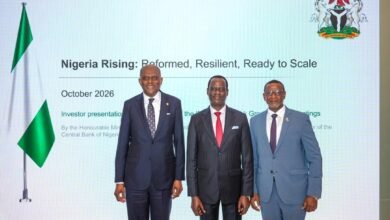
The Federal Ministry of Finance disclosed this in a statement issued on Sunday in response to interpretations of the World Bank’s October 2026 Nigeria Development Update, which showed that interest payments exceeded reported federal revenue during the period.
According to the ministry, federal revenue rose from ₦3.6 trillion in the first half of 2025 to ₦6.2 trillion in the corresponding period of 2026, while interest payments increased by 38 per cent, from ₦5.6 trillion to ₦7.7 trillion.
The development reduced the gap between interest payments and revenue from ₦2 trillion to ₦1.5 trillion, representing a 32-percentage-point improvement in the interest-to-revenue ratio.
The ministry maintained that the figures demonstrated improving fiscal performance rather than worsening debt sustainability.
It argued that the widely reported 124 per cent ratio was based on an incomplete revenue figure and included debt obligations serviced by the Federal Government on behalf of other tiers of government, particularly external loans contracted by states.
According to the ministry, comparing such obligations exclusively against federal revenue overstated the government’s debt servicing burden.
It further explained that the revenue figure excluded income already earned by government agencies and enterprises but not yet remitted to the Treasury.
The ministry also noted that federal revenue typically increases in the second half of the year because of the statutory timing of certain tax payments.
Citing the previous year’s performance, it said the interest-to-revenue ratio stood at 156 per cent in the first half of 2025, while the full-year debt-service-to-revenue ratio declined to below 60 per cent, compared with 97 per cent before the administration’s fiscal reforms.
The ministry cautioned against using a six-month fiscal snapshot as the sole basis for assessing Nigeria’s debt sustainability.
It said the same World Bank report projected Nigeria’s full-year 2026 debt-service-to-revenue ratio, covering both principal and interest payments, at 46 per cent.
However, the projected full-year debt-service ratio is not directly comparable with the first-half interest-to-revenue ratio because the indicators cover different periods and debt payment components.
The ministry also maintained that all federal borrowing remained within limits approved by the National Assembly under the 2026 Appropriation Act and the approved borrowing plan, in compliance with relevant fiscal and debt management laws.
It urged analysts and commentators to assess public finance figures using comparable data and appropriate reporting periods.
Despite the improvement recorded in the first half of 2026, interest payments still exceeded reported federal revenue by ₦1.5 trillion, highlighting the continuing pressure of borrowing costs on government finances.