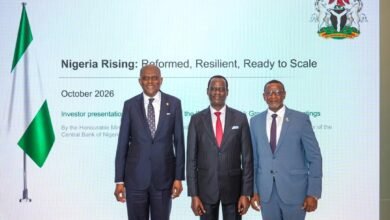


The Federal Government has unveiled a proposed economic policy framework designed to improve policy predictability, strengthen accountability in economic decision-making and introduce measurable indicators for assessing the impact of government policies on Nigerians’ living standards.
The Minister of Finance and Coordinating Minister of the Economy, Taiwo Oyedele, presented the draft Nigeria Economic Policy Framework on Monday at the 32nd Nigerian Economic Summit (NES32), outlining proposals for mandatory Policy Impact Statements and an annual National Economic Scorecard.
The framework, which is open for public consultation until November 27, 2026, seeks to establish consistent principles for economic policymaking, reduce regulatory uncertainty and provide greater clarity for businesses and investors.
Oyedele explained that the document was neither a development plan nor a catalogue of government projects, but a proposed national economic doctrine intended to guide economic decisions beyond the tenure of any administration.
“Policy uncertainty is an invisible tax on enterprise. Unlike most taxes, it raises no revenue. It only destroys value and discourages investment,” he said.
Under the proposal, every major economic intervention would be accompanied by a Policy Impact Statement detailing the problem it seeks to address, the evidence supporting the intervention, its expected beneficiaries, the costs involved and the circumstances under which the policy would end.
The measure is intended to promote evidence-based decision-making and greater transparency in the formulation and implementation of economic policies.
The framework also proposes the publication of a National Economic Scorecard annually on or before October 1, Nigeria’s Independence Day, to assess whether economic policies are delivering tangible improvements in citizens’ welfare.
Rather than relying solely on headline economic growth figures, the scorecard would track indicators such as real wages, productive employment and poverty reduction.
The proposed approach places greater emphasis on whether economic growth translates into increased purchasing power, improved job opportunities and better living conditions for Nigerians.
The framework is structured around seven interconnected pillars covering economic stability, productivity, enterprise, capital, people, markets and institutions.
These pillars are intended to provide a consistent basis for policy formulation, strengthen coordination across economic institutions and support an environment in which businesses can make long-term investment decisions with greater confidence.
For investors and private-sector operators, the proposed requirement for impact assessments could provide greater visibility into the rationale, expected costs and duration of major economic interventions.
It could also make it easier to assess the potential implications of government decisions for investment planning, business operations and household welfare.
However, the effectiveness of the proposed measures would depend on the quality of supporting data, the transparency of policy assessments and the capacity of public institutions to implement the framework consistently.
Oyedele also emphasised the need for an economic environment in which private enterprise drives production, investment and job creation, supported by fair competition and coordinated government policies.
On industrial development, he argued that trade tariffs should help domestic industries develop the capacity to compete rather than provide indefinite protection for inefficient businesses.
The minister maintained that government institutions must consider the combined impact of their decisions on businesses, noting that enterprises experience the cumulative effect of regulations, taxes and other policy interventions.
In a further move to promote long-term policy consistency, Oyedele disclosed that the government was considering whether key principles of the proposed framework should eventually be backed by legislation.
Such an approach, if adopted, could provide a legal basis for maintaining agreed economic policy principles across successive administrations and limiting arbitrary policy reversals. However, no legislation has been approved, and the question remains part of the consultation process.
The minister said the framework would be subjected to public scrutiny through 17 consultation questions, allowing stakeholders to contribute to its development.
Following the consultation and validation process, the document is expected to proceed to the Federal Executive Council for approval and subsequently to the National Economic Council for endorsement.
Oyedele stressed that the framework remains a consultation draft rather than an approved government policy, adding that building broad national consensus would be essential to its long-term relevance.
He urged businesses, professional associations, academics, civil society organisations and other Nigerians to critically examine the proposals and submit evidence-based recommendations before the November 27, 2026 deadline.
The consultation is accessible through the Federal Ministry of Finance website