
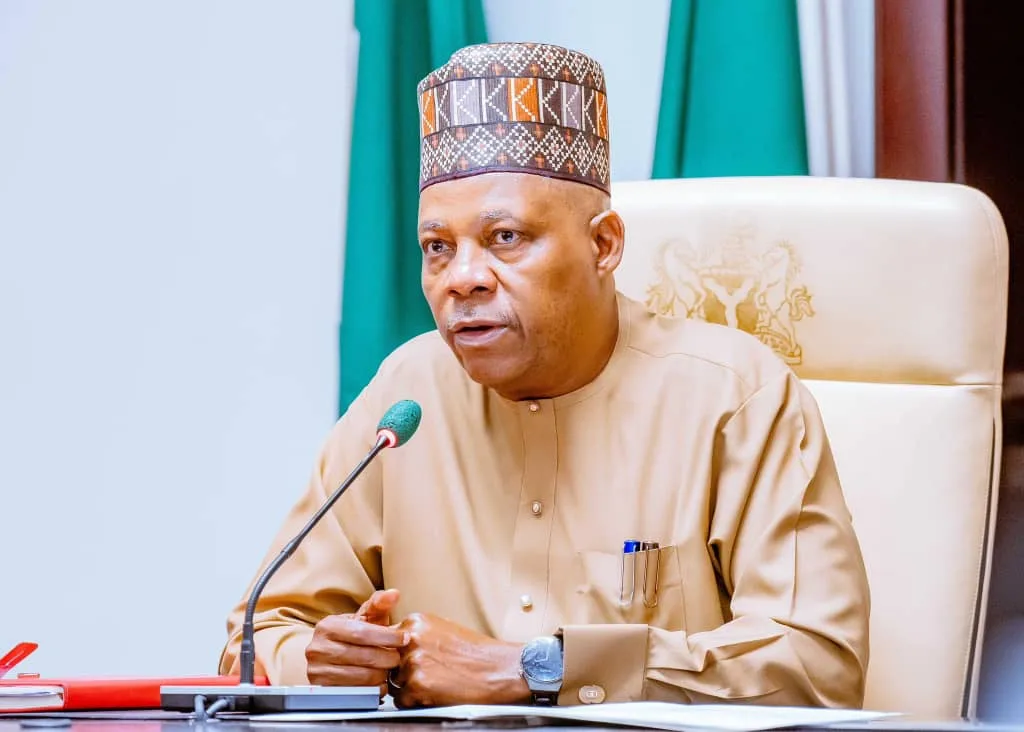
Vice President Kashim Shettima has urged state governments to accelerate business-enabling reforms under the $750 million State Action on Business Enabling Reforms (SABER) programme, saying stronger implementation is critical to attracting investment, boosting economic growth and advancing Nigeria’s ambition of becoming a $1 trillion economy.
Shettima made the call on Tuesday during a stakeholder meeting on optimising the implementation of the World Bank-assisted programme at the Presidential Villa, Abuja.
In a statement signed by Stanley Nkwocha, Senior Special Assistant to the President on Media and Communications (Office of the Vice President), Shettima said state governments play a crucial role in creating the conditions that determine investors’ experiences and business performance across the country.
He noted that effective implementation of the SABER programme would help create a more predictable and transparent business environment, attract domestic and foreign investments, reduce the cost of doing business and strengthen private-sector confidence.
The Vice President said the programme would also support the expansion of digital and physical infrastructure, improve access to land and commercial justice systems and enhance the competitiveness of states.
“These outcomes will translate into increased economic activity, higher productivity, job creation, improved internally generated revenue, and better living standards for our citizens,” he said.
To enable states maximise the programme’s benefits, Shettima directed the Director-General of the Presidential Enabling Business Environment Council (PEBEC), Zarah Mustapha-Audu, to initiate efforts toward extending the lifespan of the programme by one year.
He said the extension would provide states with additional time to fully utilise the opportunities offered under the initiative and improve their performance against key reform indicators.
The Vice President linked the success of President Bola Tinubu’s economic reform agenda to improvements in the business environment at the state level, noting that many of the factors influencing investment decisions are under the control of subnational governments.
“As a nation, we have embarked on a bold economic reform agenda under the leadership of President Bola Ahmed Tinubu. The success of this agenda depends significantly on our ability to create an enabling environment for businesses to invest, expand and create jobs,” he said.
“While the Federal Government continues to implement reforms at the national level, the reality remains that many of the conditions that define the experience of investors and businesses are determined at the subnational level. This is why the role of state governments in the implementation of SABER is critical.”
Earlier, Minister of State for Budget and Economic Planning Doris Uzoka-Anite urged stakeholders to address implementation bottlenecks to ensure the programme delivers its intended outcomes in line with the administration’s Renewed Hope Agenda.
She expressed confidence that participating states would fully access the performance-based funding available under the programme.
Providing an overview of implementation progress, PEBEC Director-General Zarah Mustapha-Audu said the council remained committed to removing bureaucratic barriers and working with government institutions, civil society organisations and the private sector to achieve the programme’s objectives.
She added that participating states were making progress toward meeting the disbursement-linked indicators required to access funding under the initiative.