
The Federal Government has reassured Nigerians living in South Africa of their safety amid growing concerns over xenophobia, anti-immigrant protests, and reports of attacks targeting foreign nationals.
The assurance comes as fresh demonstrations against undocumented migrants swept across major South African cities, prompting renewed calls for stronger diplomatic engagement between both countries.
The latest wave of tension also coincided with the arrival of another batch of 269 Nigerians evacuated from South Africa. The returnees landed at the Murtala Muhammed International Airport in Lagos on Tuesday aboard an Air Peace flight from Johannesburg, marking the second government-coordinated evacuation exercise in recent weeks.
Concerns over xenophobia intensified following reports that a Nigerian businessman, popularly known as “Big Joe,” was shot dead by unidentified gunmen outside his shop in Witbank, Mpumalanga Province. South African authorities have yet to officially confirm the circumstances surrounding his death.
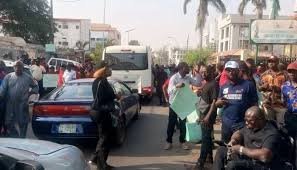
Thousands of protesters marched through several South African cities on Tuesday, demanding the removal of undocumented migrants from the country.
Authorities deployed police officers and private security personnel amid fears that the protests could descend into violence. Anti-migrant groups had previously issued a June 30 deadline for undocumented foreigners to leave the country.
Although South African police described the demonstrations as largely peaceful, authorities confirmed isolated incidents of looting and assault.
In Johannesburg, security forces maintained a strong presence in the city centre while many businesses remained closed. The military was also deployed to Hillbrow, an area with a significant migrant population, following reports of unrest, including the shooting of a teenager and the burning of a vehicle.
Local media reported that protesters in Yeoville threw bricks at homes occupied by migrants, while demonstrators in Germiston allegedly forced suspected undocumented foreigners out of their residences before handing them over to police for immigration checks.
Police confirmed the arrest of five people accused of looting a foreign-owned shop in Soweto. In KwaZulu-Natal Province, authorities arrested about 10 individuals over looting incidents, while additional arrests were made for intimidation and assault-related offences.
The leader of the anti-migrant group March and March, Jacinta Ngobese-Zuma, said the organisation plans to continue weekly protests over the next six months to pressure the government into deporting undocumented migrants.
Similarly, members of Operation Dudula vowed to continue pushing law enforcement agencies to arrest foreigners living in the country illegally.
Ahead of the demonstrations, Cyril Ramaphosa met with protest leaders in a bid to reduce tensions.
While acknowledging public concerns over immigration, Ramaphosa stressed that foreign nationals who reside legally in South Africa deserve protection under the law.
“Some foreign nationals who live in South Africa are here lawfully. They work, study, raise families, invest in our economy and contribute positively to our society. They too are entitled to the protection of our laws and our Constitution.”
The South African president also warned that the right to protest does not justify intimidation, violence, or destruction of property.
“The right to protest does not allow people to threaten or intimidate others, or to engage in acts of vandalism or violence.”
South African authorities disclosed that about 50,000 undocumented migrants have been arrested since January, while approximately 25,000 have already been repatriated, most of them from other African countries.
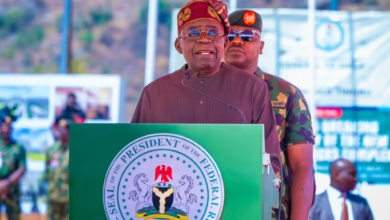
Speaking on the issue, Presidential Adviser on Foreign Affairs, Demola Oshodi, said the Federal Government remains fully engaged with South African authorities and will continue taking steps to protect Nigerians.
“We will not accept any sort of humiliation or definitely any huge damages to our interests there. It’s just not possible,” Oshodi said. “But I do assure you that we take the lives of Nigerians more seriously than even these investments that I’m talking about, and you can see that in the fact that the president has sent his ambassador there.”
“The Tinubu government is really on top of things. I’ve said we’ve moved hundreds of the most vulnerable people out of South Africa. We’ve escalated this to the South African government, and we are taking steps to do more.”
“There’s a lot of vested interest in both countries. There’s a lot of investments in both countries. We also have a history together. We have been the two largest economies in Africa. So it’s important we take things incrementally.”
“We don’t want to throw the baby out with the bathwater, as they say. So it’s watch and see what is going to happen today, the June 30 deadline they’ve given, and see how much the South African government is taking steps to protect our nationals.”
Meanwhile, Nigeria’s Acting High Commissioner to South Africa, Alexander Ajayi, revealed that the Federal Government is exploring compensation for Nigerians who abandoned businesses and properties because of the unrest.
“This repatriation will not end with just taking people to Nigeria,” Ajayi said.
“We are going to systematically follow up on the information given to us. We are going to work with the South African government to get to the exact locations of all these businesses, shops and properties and present them to the South African government for possible compensation because we will not allow the labour people have suffered to build over the years to just go down the drain or be taken over by people.”