
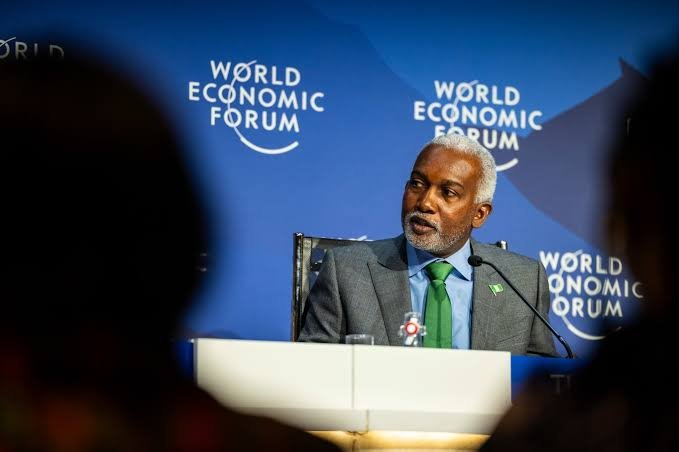
There are ministers who occupy office, and there are ministers who redefine it. Ambassador Yusuf Maitama Tuggar belongs firmly in the latter category.
When President Bola Ahmed Tinubu appointed him Minister of Foreign Affairs, Nigeria needed a diplomat that was capable of restoring coherence to its foreign policy, repositioning its voice in an increasingly fractured world, and demonstrating that diplomacy could also be measured by real outcomes. Ambassador Tuggar did precisely that.
His departure from the Ministry marks the end of one of the most consequential chapters in Nigeria’s recent diplomatic history. It also leaves a vacuum that will not be easily filled. History will likely remember his tenure for something enduring: he gave Nigeria’s foreign policy a philosophy, a direction, and a sense of purpose.
Before Ambassador Tuggar, Nigeria’s diplomacy often appeared reactive—responding to crises as they emerged and pursuing relationships that sometimes lacked an overarching strategic framework. Under his stewardship, foreign policy became intentional.
The introduction of the 4D Doctrine—Demography, Development, Diaspora and Democracy—was perhaps his greatest intellectual contribution to Nigeria’s engagement with the world.
Yes, it was an elegant acronym, but more than that, it was a carefully constructed framework that placed Nigerians themselves at the centre of diplomacy. Development was the principal objective of international engagement. Demography became a strategic advantage. The Nigerian diaspora was elevated from passive observers abroad to active partners in national development. And democracy remained both a domestic commitment and a regional responsibility.
It was the rare policy doctrine that was both intellectually coherent and practically applicable.
Closely connected to this was another defining idea that Ambassador Tuggar championed with remarkable clarity: strategic autonomy. At a time when geopolitical competition was increasingly demanding that countries chose sides, Nigeria chose instead to choose itself.
Ambassador Tuggar consistently argued that Nigeria’s foreign policy should be guided not by ideological camps or inherited alliances, but by national interest. The result was a balanced diplomacy that deepened engagement with China, India, Brazil and the Gulf states while simultaneously strengthening relations with traditional partners including the United States, the United Kingdom and the European Union.
It ensured that Nigeria remained a trusted interlocutor across competing global blocs while preserving the flexibility to negotiate from a position of independence.
Yet perhaps the most remarkable feature of Tuggar’s diplomacy was his determination to ensure that foreign policy produced tangible economic returns. Under his leadership, diplomacy increasingly became an instrument of development. Nigeria secured billions of dollars in investment commitments, including $14 billion from India across strategic sectors and €250 million in support for Nigerian businesses through partnerships with the Netherlands. Strategic agreements were concluded with major global powers including Germany, China, Saudi Arabia, France, Qatar, Brazil, India and the United Kingdom, each carefully aligned with sectors capable of driving national development.
The remarkable oversubscription of Nigeria’s Eurobond issuance during this period reflected growing international confidence in the country’s reform agenda.
His influence extended well beyond bilateral relationships. Ambassador Tuggar understood that Nigeria’s destiny is inseparable from that of West Africa. That conviction found its clearest expression in the launch of the West Africa Economic Summit (WAES)—an initiative that may ultimately become one of the most important regional innovations of this administration.
Unlike the many conferences that end with polished communiqués and little else, WAES was deliberately structured around implementation. Presidential roundtables, CEO forums, investment deal rooms and business expos transformed diplomacy into commerce and regional integration into practical opportunity.
It reflected Ambassador Tuggar’s belief that Nigeria should not merely lead West Africa by virtue of its size, but also through ideas, institutions and economic leadership. The summit repositioned the country as a convener of regional economic thinking and leadership.
He showed similar ambition on the continental stage.
Nigeria’s successful campaign to secure a permanent seat on the Board of the proposed African Central Bank was no accident. It was the product of persistent diplomacy, strategic coalition-building and painstaking negotiation.
Likewise, Nigeria emerged with stronger influence within the African Union’s institutional architecture while advancing its positions on maritime security, democratic governance, regional integration and economic reform.
He also played a decisive role in securing the election of Nigeria LNG Managing Director Dr. Philip Mshelbila as Secretary-General of the Gas Exporting Countries Forum—another strategic victory that strengthened Nigeria’s influence in global energy governance.
Perhaps nowhere was Ambassador Tuggar’s vision more evident than in Nigeria’s engagement with global platforms.
For decades, Nigeria attended international gatherings such as the World Economic Forum in Davos largely as a country of unrealised potential. Under Tuggar’s watch, that changed. The establishment of Nigeria House at Davos transformed the country’s presence from passive participation to active engagement. It provided a permanent sovereign platform for investment discussions, policy dialogue and commercial partnerships, projecting a Nigeria increasingly interested in closing deals rather than making declarations.
His diplomacy also carried an unmistakable normative dimension. The launch of the Regional Partnership for Democracy with the United Nations Development Programme represented a bold attempt to strengthen democratic governance across West Africa through African-led solutions.
Rather than merely condemning democratic backsliding, Nigeria under Ambassador Tuggar sought to build institutions capable of preventing it. It was an ambitious initiative rooted in a simple but powerful belief: that African democracy should be defended by Africans, through African institutions and according to African realities.
That philosophy reflected Ambassador Tuggar’s broader diplomatic style. He was principled without being ideological. Confident without being combative. Intellectual without becoming inaccessible. And there was grace in the way he represented Nigeria. And there was swagger in the confidence with which he defended its interests.
He carried himself with the assurance of someone who understood that diplomacy is not an exercise in pleasing others, but in advancing one’s nation with dignity.
Whether engaging global powers, defending Nigeria’s sovereignty, negotiating difficult regional issues or articulating new diplomatic ideas, Ambassador Tuggar consistently projected quiet confidence backed by substance. That combination earned him something increasingly rare in international diplomacy: respect.
Even after leaving office, he continues to receive invitations to major international engagements—from Venezuela to Oslo—not merely as a former minister, but as a respected diplomatic voice whose ideas continue to command attention.
That says something. Great public servants often leave behind institutions that function better because they served. Ambassador Tuggar leaves behind a foreign ministry that became more strategic, more intellectually confident and more closely aligned with Nigeria’s economic aspirations.
He also leaves behind a foreign policy architecture that future administrations would be wise to preserve rather than discard.
His decision to seek the governorship of Bauchi State reflected the same instinct that characterised his diplomatic career: a desire to serve. I, like many believed—and still believe—that he possessed both the competence and vision to transform the state.
That opportunity was denied, not by the electorate, but by the familiar machinery of political intrigue. The schemers and plotters who manipulated the process may have secured a temporary political victory, but Bauchi lost the opportunity to be led by one of the country’s most accomplished public servants.
That loss belongs not to Ambassador Tuggar. It belongs to the people who were denied the chance to choose him. As one chapter closes, two truths remain difficult to dispute. Nigeria has lost an exceptional Foreign Minister whose ideas reshaped the country’s diplomatic identity and whose leadership restored confidence in the conduct of its foreign policy.
And Bauchi has missed the opportunity to be governed by a leader whose record suggests he would have brought the same vision, discipline and strategic thinking to statecraft.
The measure of a public servant is often clearest after they leave office. By that standard, Ambassador Yusuf Maitama Tuggar has already secured his place. Nigeria will miss him. Bauchi already does.
Eyimofe Amajuoritse is a journalist covering Nigeria’s foreign relations.