

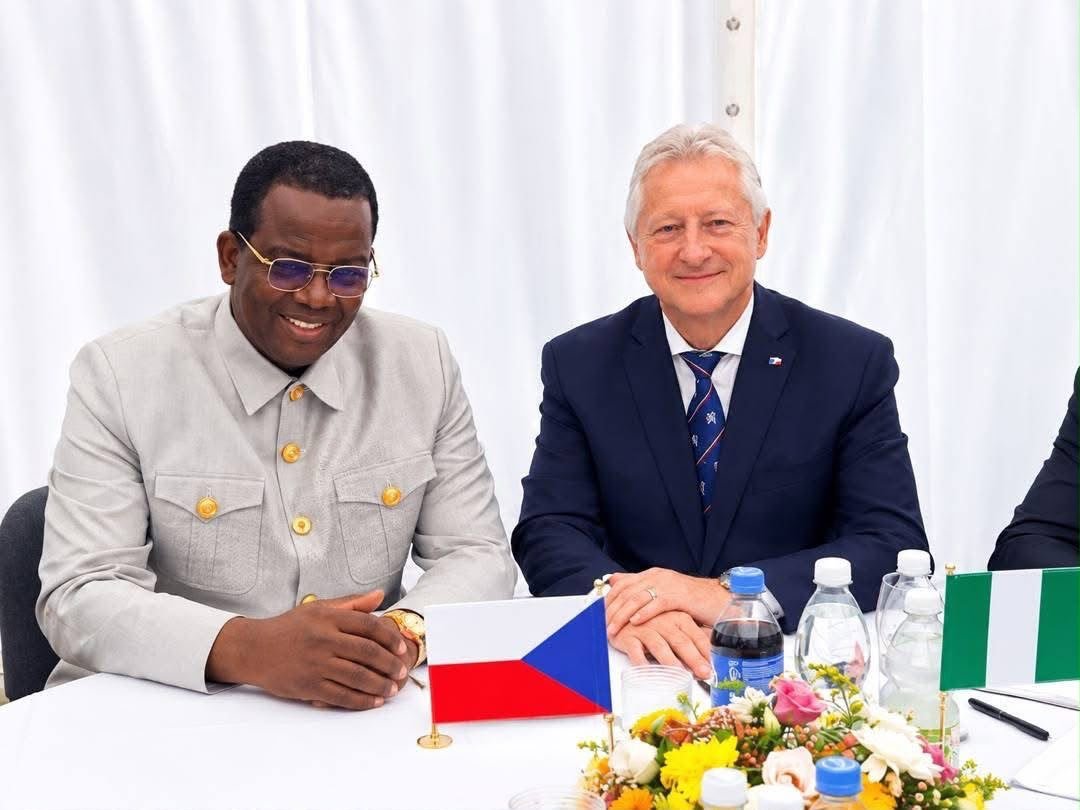
A defence exhibition is designed to impress. Fighter aircraft sweep across the sky, armoured vehicles glisten on the ground and manufacturers display increasingly sophisticated drones, weapons and surveillance systems. But for Nigeria’s delegation to the Czech Air Force Day, Air Show and Defence Exhibition in Ostrava, the more consequential question went beyond what was being exhibited for purchases, but most crucially, what could be produced at home.
That distinction lies at the heart of the three-day working visit to the Czech Republic led by Nigeria’s Minister of State for Defence, Dr Bello Muhammed Matawalle. Accompanied by senior officials of the Ministry of Defence, the Defence Industries Corporation of Nigeria (DICON) and the National Agency for Science and Engineering Infrastructure (NASENI), the minister used the visit to pursue a more ambitious form of defence cooperation: an ammunition-production line in Nigeria and the transfer of technology for unmanned aerial vehicles and other military equipment.
This is a sound ambition. Nigeria has spent decades confronting terrorism, banditry, piracy, kidnapping and other forms of organised violence. Yet much of the equipment required to prosecute these campaigns is still obtained from abroad. That dependence is expensive, exposes the country to foreign-exchange pressures and can leave military operations vulnerable to delayed deliveries, shifting diplomatic calculations and disrupted global supply chains.
The discussions in the Czech Republic therefore concern more than another round of defence procurement. They point towards a gradual reordering of Nigeria’s defence economy—from buying finished products to acquiring the capacity to design, manufacture, maintain and improve them.
“Technology transfer” is easily reduced to diplomatic jargon. Properly understood, however, it is the difference between importing a machine and learning how to build, operate, repair and eventually improve it.
Genuine technology transfer may include the licensing of designs and production methods; installation of machinery and tooling; training of Nigerian engineers and technicians; access to technical documentation; assistance with testing and quality assurance; and the development of local suppliers capable of producing components to military standards. It should also involve knowledge of maintenance, software integration, systems engineering and research and development.
In other words, technology transfer is not the delivery of crates accompanied by instruction manuals. Nor should it amount merely to assembling imported parts indefinitely. Its purpose is to ensure that, over time, a Nigerian institution can perform more of the production process itself, adapt equipment to local operational needs and build a pool of knowledge that remains in the country.
This is particularly important for unmanned aerial vehicles. Drones are no longer peripheral tools of modern warfare. They are used for intelligence gathering, surveillance, border monitoring, targeting, communications support and the protection of strategic assets. Nigeria’s security challenges—from forests and difficult borderlands to maritime corridors and oil infrastructure—make such systems especially valuable.
But owning drones is not the same as possessing drone capability. Aircraft must be maintained. Sensors must be integrated. Software must be updated. Operators and engineers must be trained. Spare parts must be available. Data must be securely managed. Without these supporting capabilities, expensive platforms can eventually become grounded assets.
A well-designed partnership with the Czech Republic could help Nigeria develop this wider ecosystem. The Czech defence industry has longstanding experience in military engineering, aviation, ammunition and specialised manufacturing. Nigeria, meanwhile, possesses a large domestic market, an expanding engineering base and an urgent operational requirement. The two countries therefore have complementary interests.
The proposal for a domestic ammunition-production line may attract less attention than fighter aircraft or sophisticated drones, but it could have a more immediate operational impact.
Ammunition is consumed continuously during training and combat. A country that depends excessively on imports for such an essential input places its military preparedness partly in the hands of overseas suppliers. International shortages, shipping disruptions, export restrictions or diplomatic disagreements can quickly become battlefield constraints.
Local production would not eliminate the need for imports, nor should self-sufficiency be confused with isolation. Modern defence manufacturing depends on international partnerships and specialised supply chains. The objective is instead to reduce dangerous exposure by ensuring that Nigeria can reliably produce a meaningful portion of its most frequently required military supplies.
DICON already has a statutory mandate covering the production of arms and ammunition for the Armed Forces. Nigeria’s more recent defence-industry framework also places emphasis on local manufacturing, innovation, technology transfer and private-sector participation. The challenge is to translate that mandate into production at sufficient scale, quality and consistency.
This is where the Czech discussions matter. A production line is not merely a collection of machines. It requires metallurgy, chemical engineering, precision manufacturing, rigorous testing, secure storage, reliable power, disciplined procurement and internationally acceptable quality-control systems. These are capabilities that must be built methodically.
The involvement of NASENI is therefore notable. Defence industrialisation cannot be confined to a military institution. It requires civilian engineering expertise, research establishments, universities, manufacturers and technology companies. Bringing DICON and NASENI into the same delegation suggests an appreciation that defence production is ultimately an industrial-policy project as much as a security project.
The potential benefits even extend beyond Nigeria.
West African countries face many of the same security threats, but most lack the market size or capital required to establish sophisticated defence-production facilities of their own. They purchase equipment from distant suppliers, often at considerable cost and with long delivery times. A credible Nigerian defence industry could eventually serve part of this regional demand.
Nigeria has the scale to become a West African centre for the production, maintenance and repair of selected military equipment. Ammunition, protective equipment, surveillance systems, drones, communications tools and replacement parts could all form part of a regional industrial proposition, subject to strict Nigerian law, international obligations and end-user safeguards.
The economic logic is compelling. Domestic production could conserve foreign exchange, create skilled employment and support businesses in engineering, electronics, metals, chemicals, software and logistics. Regional exports could help factories achieve the scale needed to remain commercially viable. Maintenance and training services could generate additional revenue while strengthening security cooperation among neighbouring states.
There would also be a strategic benefit. A region that can supply and maintain more of its essential security equipment is less exposed to events elsewhere. Shorter supply chains make repairs and replenishment faster. Equipment can be adapted to West African terrain and operating conditions. Regional forces would also have greater opportunities to use compatible systems, simplifying training and joint operations.
Nigeria should not presume that regional customers will purchase its products merely out of solidarity. Defence procurement is exacting. Equipment must be reliable, competitively priced and delivered on schedule. Production must comply with recognised standards, and exports must be protected against diversion to terrorists, criminal networks or unauthorised users. Regional leadership will have to be earned on the factory floor.
The Czech side’s stated willingness to support Nigeria’s defence-production ambitions is encouraging. But visits and assurances are only a beginning.
The real test will be whether the engagement produces specific agreements: what technologies will be transferred; what will be manufactured in Nigeria; how many Nigerians will be trained; what intellectual-property and licensing rights will apply; how much local content will be required; and when Nigerian engineers will be able to operate the facilities without permanent foreign dependence.
Progress should be measured not by the number of memoranda signed, but by functioning production lines, certified products, trained personnel, dependable local supply chains and equipment that performs in the field.
Matawalle’s role deserves recognition. By placing technology transfer and domestic ammunition production at the centre of his engagement with the Czech defence leadership, the minister is steering the conversation beyond conventional arms purchasing. His visits to defence and security industrial complexes should provide the delegation with a practical view of how research, engineering, private capital and military demand can be organised into a functioning industrial system.
The approach also fits a broader effort to reposition DICON as an institution capable of reducing dependence on foreign supplies and eventually competing in wider defence markets. The Ministry of Defence identifies local manufacturing and export readiness as central elements of this effort.
These partnerships must build Nigerian competence rather than create another permanent channel for importing components.
The visit to the Czech Republic is therefore significant not because it instantly delivers defence self-sufficiency. No single trip can do that. Its importance lies in the model it advances: partnerships based not only on what foreign manufacturers can sell to Nigeria, but on what they can help Nigeria learn to produce.
If that principle is pursued with discipline, the gains could reach well beyond the Armed Forces. Nigeria could strengthen its security, expand its engineering base, reduce pressure on foreign exchange and build a defence industry capable of serving responsible customers across West Africa.
The aircraft and armoured vehicles displayed in Ostrava offered a glimpse of what mature defence industries can manufacture. Nigeria’s task is to ensure that future exhibitions do not merely provide another shopping list. They should provide a blueprint for production at home.
– Dahiru Bashir Hassan is a security researcher and writes from the FCT