
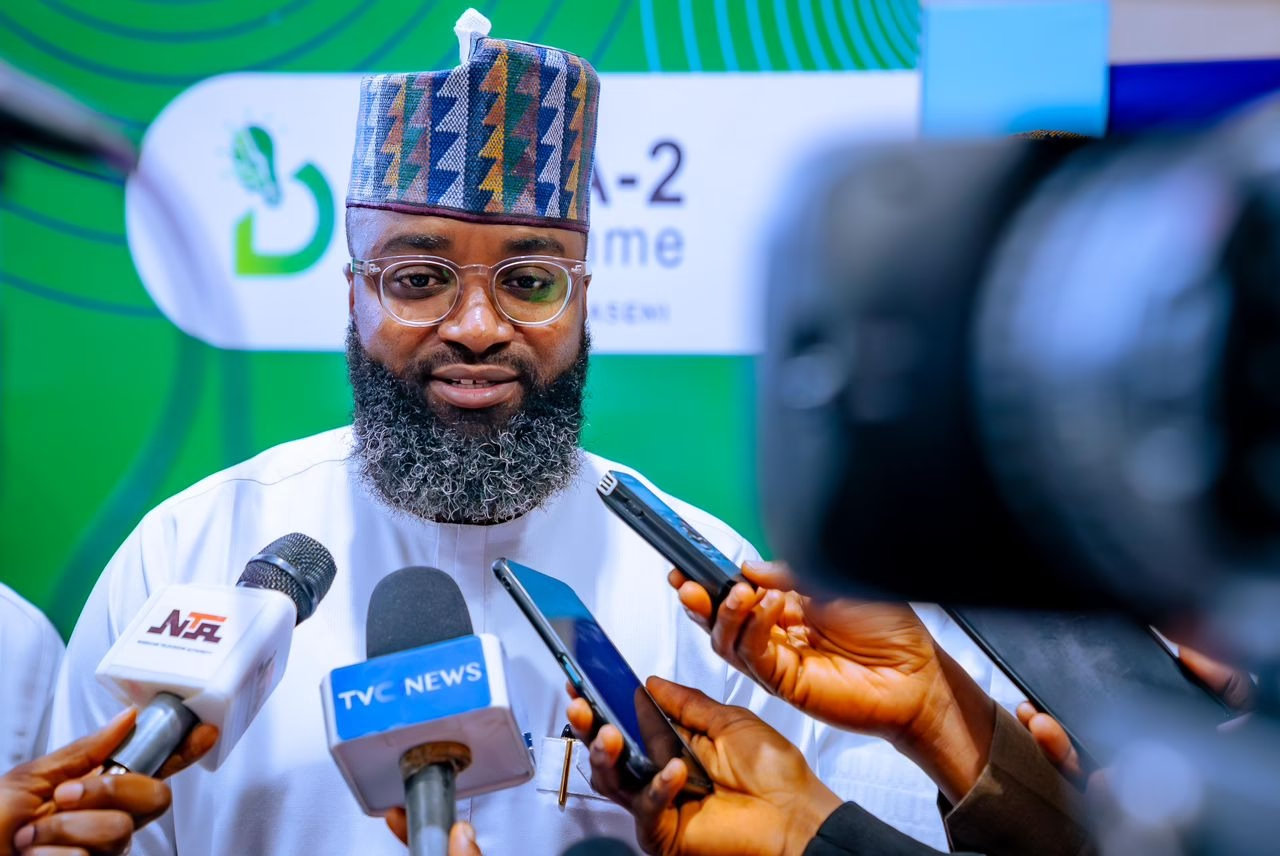
As he often says, “Nothing bad happens on a Friday.” For the National Agency for Science and Engineering Infrastructure (NASENI), the whole of 2025 proved to be a strong and defining year. The agency continued to build on the foundation laid since Khalil Halilu assumed leadership—transforming NASENI beyond its refreshed bluish branding into an institution that is attractive not only in design, but also in delivery and tangible outcomes.
For years, NASENI was best known in policy circles as a research-heavy institution—important, but distant from the everyday realities of Nigerians. Its outputs were often measured in reports, concept papers, and pilot ideas. That perception changed decisively in 2025.
Under the leadership of Khalil Halilu, its Executive Vice Chairman and Chief Executive Officer, NASENI began to speak a different language: one of products, factories, partnerships, and people. It was no longer just about ideas; it was about outcomes Nigerians could touch, use, and rely on.
Every Friday, I have watched Halilu post his simple message on his social media platforms: “Nothing bad happens on a Friday.” The phrase has become something of a personal mantra. Coincidentally—or perhaps fittingly—he himself was appointed by President Bola Ahmed Tinubu on a Friday. By the end of 2025, the phrase had come to symbolise something larger: a leadership style anchored in optimism, urgency, and a belief that Nigeria can build for itself.
Khalil Halilu began the year 2025, precisely on 9 January 2025 with a guest, Mohammed Jammal—popularly known as White Nigerian—at NASENI’s Abuja headquarters.
During the interaction, Halilu showcased indigenous drone prototypes, solar home systems, and other technologies developed by young Nigerian engineers within NASENI. The discussion moved quickly to representation, visibility, and access. How could NASENI become more visible to young innovators? How could government research institutions feel open rather than intimidating?
Ideas flowed freely: whether it was the suggestion for a Youth Innovation Ambassador programme, a national Inventors Challenge with seed funding, and the creation of platforms where young Nigerians could test ideas using NASENI’s fabrication labs. At the heart of Khalil’s message was his guiding philosophy: Innovate, Incubate, Integrate. A framework that mirrors his broader mantra of creation, collaboration, and commercialisation.
That early engagement set the tone for the year. NASENI in 2025 would be open, youthful, and responsive.
Just days later, on 13 January, Halilu turned outward—this time to China. In a meeting with Ambassador Yu Dunhai, discussions centred on clean energy, electric mobility, and technology transfer. NASENI’s solar panel production ambitions and electric vehicle prototypes were no longer abstract ideas; they were projects actively seeking scale.
Solar power has become an essential solution for bridging Nigeria’s energy gap—whether for businesses or households—and addressing this core need sits at the heart of Khalil Halilu’s vision for NASENI.
At the meeting, concrete plans were laid for Nigerian engineers to undergo training at Chinese research centres, particularly in battery technology, robotics, and advanced manufacturing. Within months, these plans materialised, with NASENI engineers completing intensive training programmes in Shenzhen.
This approach reflected Khalil’s understanding that technology transfer is only effective when local institutions possess the capacity to absorb, adapt, and scale imported expertise.
If innovation is the spark, financing is the fuel. On 11 February, Halilu hosted Jaiz Bank’s leadership to discuss how Islamic finance could support NASENI’s journey from laboratory to factory floor. The conversation was grounded in realism of the Nigerian context: Many a Nigerian businessman does not lack ideas; they lack pathways to commercialisation.
Proposals emerged for an innovation fund, SME financing for NASENI-backed technologies, and joint industrial hubs.
When the Deputy Governor of the Central Bank of Nigeria, Mohammed Abdullahi—fondly known as Dattijo—toured NASENI’s facilities, he saw far beyond experiments. What stood before him were economic instruments: solar irrigation pumps reducing import dependence, electric vehicles conserving foreign exchange, and manufacturing tools capable of creating skilled jobs.
The visit marked a crucial moment in aligning NASENI’s vision with Nigeria’s economic policy direction, as indigenous technology decisively entered the national economic planning conversation.
Innovation, Khalil Halilu understands, is also about sovereignty. His engagements with DICON reflected NASENI’s growing role in security-related engineering—from drones to surveillance systems and local fabrication of critical components.
The creation of joint defence-tech task teams ensured that these efforts moved beyond meetings into measurable outcomes. For NASENI engineers, it was validation that their work mattered at the highest levels of national security.
By April 2025, NASENI’s transformation was evident enough to warrant direct presidential attention. A tour led by Halilu for the President’s Special Adviser on Innovation showcased 35 indigenous technologies—each one a marker of progress.
Presidential backing followed, reinforcing Khalil’s leadership and NASENI’s transformation, credibility and momentum.
By mid-year, Khalil Halilu’s international engagements bore further fruit. Meetings with Chery Automobile in China advanced plans for local EV assembly in Nigeria—an ambitious yet calculated move.
Perhaps one of the most symbolic initiatives of 2025 was the launch of #ReverseJapa in partnership with NiDCOM. Rather than lamenting the loss of talent, NASENI under Khalil sought to reconnect it.
It is no gainsaying that by the end of 2025, NASENI had forged itself in the centre of Nigeria’s conversations on the domestic production of technologies that serve the Nigerian people. It had become a household name in engineering circles and increasingly among everyday Nigerians. Solar kits on farms, diagnostic tools in clinics, prototypes moving toward mass production.
Khalil Halilu’s year was defined by systems built, partnerships forged and products engineered. Today, NASENI has a long list of market ready products, that can cater to the needs of diverse Nigerians, whether in agriculture, or those in small and medium scale businesses.
Perhaps that is why his simple refrain resonates. Nothing bad happens on a Friday. In 2025, for NASENI—and for Nigeria’s innovation journey—it certainly felt that way.
– Bature Danlami, a technology enthusiast writes from Kano State.