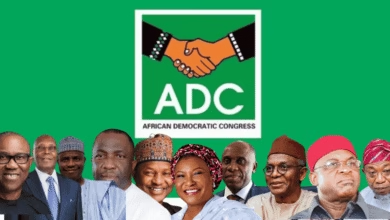


Nigeria’s ruling All Progressives Congress (APC) and opposition African Democratic Congress (ADC) have traded accusations over reports indicating a rise in the country’s poverty rate, with both parties offering sharply contrasting interpretations of the data and the economic reforms introduced by President Bola Ahmed Tinubu’s administration.
The APC accused the ADC of “mischievously misleading Nigerians” over the findings of a recent report presented at an Agora Policy dialogue, which suggested that Nigeria’s poverty rate has risen to about 63 percent from roughly 49 percent prior to May 2023.
In a statement issued in Abuja, the ruling party defended the government’s economic reforms, arguing that the removal of fuel subsidy and the unification of foreign exchange regimes were necessary measures to rescue the country from what it described as a looming fiscal crisis.
According to the APC, the fuel subsidy system had become an “existential threat” to Nigeria’s economic stability, consuming trillions of naira annually and accounting for a large share of government revenue while delivering limited benefits to ordinary citizens.
The party said President Tinubu’s decision to end the subsidy immediately after assuming office on May 29, 2023, alongside the harmonisation of multiple exchange rates, represented “bold and historic policy shifts” aimed at correcting long-standing structural distortions in the economy.
“The fuel subsidy regime enabled widespread inefficiencies, corruption, and large-scale fuel smuggling across borders,” the APC said, adding that the policy disproportionately benefited middlemen and fuel import cartels rather than Nigerians.
The party argued that removing the subsidy has freed up public funds that are now being redirected toward infrastructure development, healthcare, education, and social programmes.
However, the ADC rejected the ruling party’s claims, insisting that the economic reforms introduced by the Tinubu administration have deepened hardship and pushed millions of Nigerians into poverty.
In a statement responding to the APC, the opposition party said it was not inciting Nigerians but merely reflecting the lived realities of citizens facing worsening economic conditions.
The ADC cited data indicating that Nigeria’s poverty rate has increased to 63 percent, describing it as evidence that the government’s economic policies have failed to improve the welfare of ordinary Nigerians.
“Economic reforms must ultimately be judged by their outcomes,” the party said. “When poverty rises from about 50 percent to 63 percent and millions struggle to afford basic necessities, it is clear that something is fundamentally wrong.”
The party also highlighted developments in the food and agriculture sector, claiming that nearly 90 out of more than 150 rice mills across Nigeria have shut down operations, while others are operating far below capacity.
According to the ADC, the situation has been exacerbated by rising imports and policy choices that it said have weakened local agricultural production.
Citing figures from the National Bureau of Statistics (NBS), the party said Nigeria’s food import bill rose from ₦3.83 trillion in 2023 to ₦7.65 trillion, representing an increase of nearly ₦3.82 trillion.
The opposition party also pointed to survey data suggesting widespread dissatisfaction with the country’s economic direction.
It claimed that 93 percent of Nigerians believe the country is heading in the wrong direction, while 88 percent describe the national economy as bad, and 74 percent say their personal living conditions are poor.
The ADC further argued that rising fuel prices since the removal of subsidy have worsened inflationary pressures across the economy.
According to the party, petrol prices have risen sharply from about ₦255 per litre in May 2023 to around ₦1,500 per litre in many parts of the country, significantly increasing transportation costs and food prices.
The opposition also cited survey findings indicating widespread deprivation, including Nigerians reporting that they had gone without food, medical care, cooking fuel, clean water, or cash income at different times during the past year.
Despite these criticisms, the APC insisted that the reforms are necessary for long-term economic stability and that the current hardship represents a temporary adjustment period.
The party accused the ADC of failing to propose credible policy alternatives while focusing primarily on attacking government policies.
The exchange highlights the deepening political debate surrounding the Tinubu administration’s economic reforms as Nigerians continue to grapple with rising living costs and structural changes aimed at stabilising the economy.