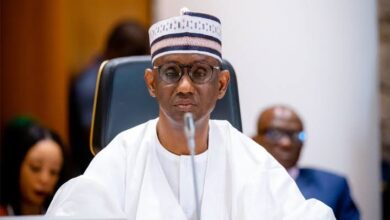


Nine months is not a long time in the life of a bilateral relationship. Alliances forged over decades of shared interest can take longer than that simply to schedule a first meeting. Yet in the space of nine months—from late October 2025 to early July 2026—Nigeria and the United States travelled the distance from formal rebuke to formal commendation, from the language of concern to the language of comradeship. Any historian tracing that arc will find, at almost every turning point, the same hand at work: that of Nigeria’s National Security Adviser, Mallam Nuhu Ribadu.
The story begins, as these things often do, with a misreading. In late October 2025, the United States designated Nigeria a Country of Particular Concern under the International Religious Freedom Act—a label reserved for states judged to tolerate systematic religious persecution. The designation carried real weight in the US’ foreign-policy imagination, and it arrived at a moment when Nigeria was already contending with insurgency, banditry, and communal violence on several fronts. For a government managing a genuinely complex security landscape, being cast abroad as the site of a singular sectarian crisis was both a mischaracterisation and a liability.
President Bola Ahmed Tinubu’s response was not to protest from a distance but to send his most trusted hand into the room where the narrative was being written. Within weeks, Mal. Nuhu Ribadu was leading a Nigerian delegation to Washington, moving through the White House Faith Office, the State Department, the National Security Council, the Department of War, and the corridors of Congress—the very institutions where the CPC designation had taken shape. The delegation’s argument was not defensive so much as corrective: Nigeria’s violence, they insisted, cut across faith and ethnicity alike, a blend of terrorism, banditry and criminality rather than a one-sided campaign against any single community.
If there was a single hinge in this story, it was Mal. Ribadu’s meeting with the US Secretary of War, Pete Hegseth, during that November visit. The United States at the time was still speaking publicly of the plight of Nigerian Christians; Mal. Ribadu’s task was to reframe that concern as one component of a shared threat rather than the whole of it—Boko Haram, Islamic State affiliates and armed bandit groups threatening Nigerians of every faith. The tone that emerged from that exchange proved durable. Within days, both governments had agreed to establish a Joint Working Group, co-chaired on the Nigerian side by Mal. Ribadu, bringing together defence, intelligence, foreign affairs, police and humanitarian officials under a single coordinating structure.
In early December, too, a delegation of US lawmakers travelled to Abuja for what was billed as a fact-finding and partnership mission—itself a marked departure from the punitive posture that had accompanied the CPC designation months earlier.
Diplomacy is judged, ultimately, by what it makes possible operationally, and here the record turned quickly. On 25 December 2025, US Africa Command conducted strikes in Nigeria’s northwest, in areas around Sokoto State, against Islamic State–linked positions—not a unilateral American action of the kind Nigeria had reason to fear months earlier, but a coordinated strike carried out with Nigerian consent and Nigerian intelligence. Three weeks later, on 13 January 2026, American forces delivered military supplies to Nigerian security agencies in Abuja, a delivery AFRICOM framed explicitly as counterterrorism support under the emerging partnership.
Intelligence cooperation deepened alongside the hardware. Surveillance flights and daily intelligence-sharing became, according to Nigerian security sources, more extensive than at any point in recent memory—cooperation credited with disrupting plots that might otherwise have succeeded.
By May 2026, the relationship had matured enough to move from operational cooperation into sustained high-level diplomacy. Mal. Ribadu met at Vice President J.D. Vance’s residence with Vance himself, and separately with Secretary of State and Acting National Security Adviser Marco Rubio, alongside Under Secretary for Political Affairs Allison Hooker and Assistant Secretary of War Daniel Zimmerim. The talks ranged across counterterrorism, defence cooperation, intelligence sharing, regional stability and economic resilience—a far broader agenda than the narrow security-versus-religion framing of the previous October. Days later, a coordinated strike in the Lake Chad Basin eliminated Islamic State commander Abu-Bilal Al-Manuki (also identified as Abubakar Al-Minoki) and several of his lieutenants, an operation both governments would later point to as the clearest demonstration yet of what the Joint Working Group had built.
The momentum continued into July, when newly confirmed Assistant Secretary of State for African Affairs Frank Garcia made Nigeria the centrepiece of his first official Africa tour, holding extensive talks with Mal. Ribadu on security, justice-sector reform, digital transformation and regional stability.
It was against this accumulated record that Donald Trump’s letter of 6 July 2026 landed—as the public acknowledgment of a partnership that had already been tested in the field. President Trump praised President Tinubu’s “decisive leadership,” called it “a true honour” to stand with Nigeria against terrorism, and disclosed that the United States had deployed Special Operations Forces, including elite units, to train and equip Nigerian troops under what he termed the historic US–Nigeria 2026 Defence Cooperation Roadmap.
Where the previous October’s designation had cast Nigeria as a cause for concern, this letter cast it as a partner whose leadership Washington was prepared to commend in writing, over the President’s own signature.
Historians are generally wary of crediting individuals for shifts that are, in truth, the product of institutions, interests and circumstance. But it would be an incomplete account of this episode that did not register the specific, sustained role Mal. Ribadu played in each of its turning points—the November delegation that reset the terms of the conversation, the relationship built with Hegseth that made a Joint Working Group possible, the Washington meetings with Vance and Rubio that broadened the partnership beyond security alone, and the steady cultivation of trust that allowed operational cooperation—airstrikes, intelligence sharing, weapons transfers—to follow diplomatic engagement rather than precede it.
What the record shows, in the end, is a rare case of diplomatic sequencing done right: narrative correction first, institutional architecture second, operational cooperation third, and public recognition last—each step earning the one that followed.
The work is however far from finished. Terrorism in the Lake Chad Basin and the wider Sahel remains an evolving threat, and translating diplomatic goodwill into durable security outcomes will take years, not months. But nine months ago, Nigeria was a country under a cloud. Today, it is a country whose president receives letters of commendation from the Oval Office. That distance was not covered by chance.
— Mukhtar Sulaiman is a journalist and writes from the FCT