News
Peter Mbah’s N464bn Spent on ‘Smart School’s: Collapsed Roofs, Cracked Walls and the Questions He Must Answer
By Ferdinand Okoye

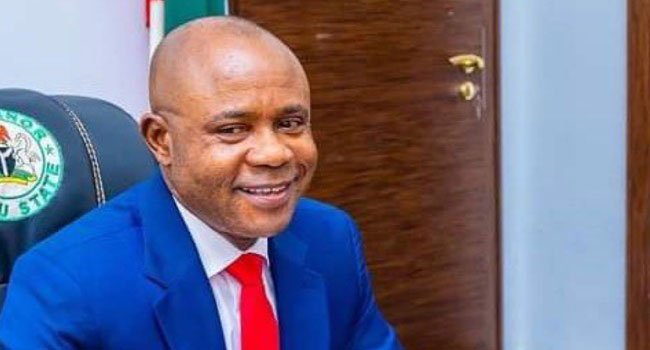
Enugu’s Smart Green Schools were sold as a revolution in public education. But reports of collapsed roofs, defective buildings and children learning amid unfinished works raise a more troubling question: how did one of the Mbah administration’s most expensive flagship programmes produce such failures—and who should be held accountable?
When Governor Peter Mbah unveiled his vision for education in Enugu State, the ambition was difficult to fault. At its centrepiece was the Smart Green School programme: 260 technology-driven schools, one in each electoral ward, conceived as modern learning environments that would help transform public education in the state.
It was the kind of project around which a government could build a legacy. But the real test of any government programme is not the sophistication of its promises. It is what taxpayers receive for their money. And on that measure, the questions surrounding Enugu’s Smart Green Schools deserve urgent scrutiny.
An investigation published in May 2026 reported troubling conditions at a number of the schools: incomplete construction, questionable workmanship and structural defects. Some of the reported problems would be disturbing in an ordinary government building. In facilities intended for children, they are potentially far more serious.
At the New Haven Smart School, rainwater reportedly entered classrooms after roofing sheets were blown off. An engineer cited in the investigation attributed the problem to an insufficient roof slope. Cracks were reported. Electrical and plumbing works remained unfinished. Bamboo scaffolding and incomplete landscaping were reportedly still visible even after children had begun attending classes.
But New Haven was apparently not an isolated case. At Ishielu Amagunze Smart Green School, a windstorm reportedly tore off part of the roof. At Amofia Nara, concerns were raised about materials and workmanship. At Iheaka, a roof reportedly collapsed after rainfall. Another failure was reported at Orba. At Mbu in Isi-Uzo, the problems were apparently serious enough for the state government itself to order the demolition of a structurally defective school.
At Amankpunato, Achi Uno, a staircase was reportedly demolished after failing integrity checks. A contractor was reportedly dismissed over cracked walls and structural defects.
The scale of expenditure in building these schools makes scrutiny unavoidable. Each Smart Green School has reportedly been estimated to cost approximately N1.3 billion to N1.5 billion. The 2025 state budget reportedly provided N266.7 billion for the programme, including approximately N100 billion for construction and N146 billion for equipment and technology.
Another N198 billion was reportedly allocated in 2026 to continue the programme and construct senior secondary schools. All of these allocations amount to about N464.7 billion across two years.
At this point questions are arising: How much has actually been released? How much has been spent? Which contractors received the contracts? How were they selected? Who certified the buildings? Who signed off on completed works? What payments were made before defects became apparent? And where defects have been established, how much will remediation cost taxpayers?
The fact that the state government itself reportedly terminated contractors and ordered defective structures demolished makes independent scrutiny highly necessary. Such actions may demonstrate that the government identified problems and acted on them. But they also raise the question of how the problems passed through procurement, supervision and quality-control processes in the first place.
A building does not ordinarily progress from foundation to roofing before numerous professionals have inspected and certified stages of work.
If walls cracked, roofs failed and structures subsequently had to be demolished, investigators need to establish whether the problem lay with contractors, materials, designs, supervision, certification—or some combination of them—or even corruption.
Another consequential question that must be answered is that of who certified these schools? Government construction is supposed to involve layers of accountability. Contractors execute projects. Consultants supervise them. Engineers assess structural integrity. Officials certify milestones. Payments are authorised against work purportedly completed.
If the reported defects are accurate, investigators need to reconstruct that chain. Who designed the affected schools? Who conducted structural calculations? Who supervised construction? Who approved the materials? Who issued certificates permitting payments? Were integrity tests conducted before students were admitted? And where a school subsequently failed an integrity test, who had previously certified it as fit?
The public deserves answers.
A programme of this financial scale and political importance ultimately sits within Peter Mbah’s administration. The Governor therefore must answer these questions and cannot be insulated from scrutiny simply because contractors physically executed the work.
The appropriate response now is an independent investigation into the Smart Green School programme and the Mbah administration’s oversight of it, including decisions for which Governor Peter Mbah bears executive responsibility.
Such an investigation should follow the money from appropriation to procurement, mobilisation, construction, certification and final payment.
Investigators should obtain the contracts, bills of quantities, tender records, payment certificates, bank trails where legally appropriate, inspection reports, structural assessments and records of contract variations. The beneficial ownership of companies awarded contracts should also be established, alongside any relationships between those companies and public officials.
The investigation should determine whether contracts were competitively procured; whether contractors possessed the required technical capacity; whether payments corresponded with work actually completed; whether officials ignored warnings about workmanship; and whether anybody authorised payment for defective or incomplete work.
Governor Mbah himself should be required to account for what he knew about failures in the programme, when he became aware of them, what reports reached his office and what corrective measures he ordered.
If the investigation establishes that the failures resulted solely from individual contractors who were subsequently sanctioned, the public should know that. If officials—including the Governor himself—failed in their supervisory responsibilities, they should be identified. If public money was lost through negligence, it should be recovered.
And if investigators uncover evidence of procurement violations, fraudulent certification, diversion of funds or corruption, those responsible—regardless of their position—should face the appropriate authorities.
The Smart Green School programme was supposed to represent the future of education in Enugu. If some of the schools instead became examples of collapsed roofs, cracked walls, unfinished works and demolished structures, then Enugu taxpayers deserve to know exactly what went wrong.
N464.7 billion in allocations is far too much public money for those questions to remain unanswered. And Peter Mbah’s administration is a part and parcel of this—he must provide answers to the questions Enugu taxpayers have!
— Ferdinand Okoye is an investigative journalist, writing from Nsukka