
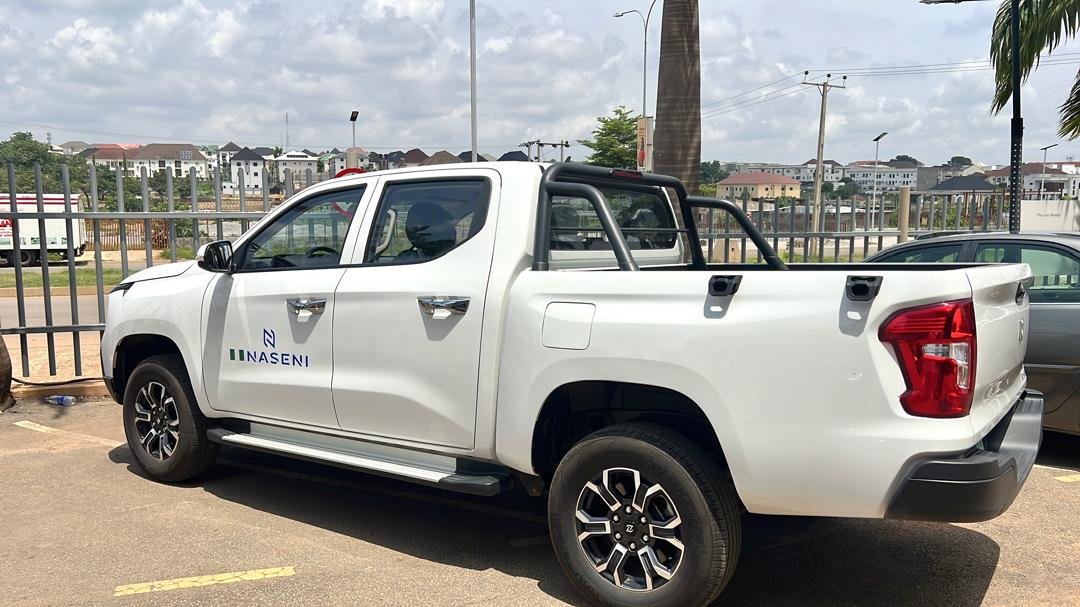
For decades, Nigeria’s industrial ambition has been loud in rhetoric and thin in execution. Too often, government-owned agencies have spoken the language of innovation without delivering products that touch everyday life. That is why the sight of a made-in-Nigeria electric sedan and pick-up truck—designed, assembled and test-driven by the National Agency for Science and Engineering Infrastructure (NASENI)—feels quietly momentous.
The reaction of one test driver, Ezinne, a banker encountering an electric vehicle for the first time, was telling. For her, she was simply surprised—by the smoothness, the silence, and the refinement of the ride. That sense of surprise matters. It is the first crack in Nigeria’s long-held scepticism that locally driven industrial projects can meet global standards.
Mind you, Electric Vehiclesp (EVs) are no longer futuristic curiosities. In much of Asia—China most conspicuously, but also parts of Southeast Asia—they now account for a substantial share of new vehicle sales. Governments there did not wait for perfect conditions. They aligned industrial policy, climate objectives and urban transport needs, and then backed domestic manufacturers with incentives, infrastructure and regulatory clarity. Nigeria is late to this party, but not locked out.
NASENI’s entry into electric vehicle manufacturing is therefore significant not merely because it is novel, but because it is strategic. Let me explain: Urban mobility in Nigeria is at a breaking point. Cities are congested, fuel costs volatile, and air quality steadily deteriorating. EVs address all three pressures at once. They produce no tailpipe emissions, reduce dependence on imported refined fuel, and—crucially for households and fleet operators—offer lower running and maintenance costs over time, despite higher upfront prices.
How do they work? At their core, EVs replace the internal combustion engine with an electric motor powered by rechargeable batteries, typically lithium-ion. Energy stored in the battery is converted directly into motion, eliminating many of the moving parts that make petrol vehicles noisy, inefficient and expensive to maintain. Fewer parts mean fewer breakdowns, too. Electricity—whether drawn from the grid, solar installations or hybrid charging systems—offers a more predictable cost base than petrol or diesel in an economy prone to energy shocks.
For Nigeria, the implications are profound. EV adoption dovetails neatly with the country’s push for renewable energy, local manufacturing and climate resilience. Fleet vehicles—buses, delivery vans, government cars—are an obvious starting point. So too are ride-hailing services operating in dense urban corridors. With the right charging infrastructure and fiscal incentives, EVs could move from what many see as an elite indulgence, to a practical solution to our mobility needs.
That NASENI is leading this charge is no accident. Under the leadership of Khalil Halilu, the agency has reoriented itself around a simple framework: the three Cs—Commercialisation, Collaboration and Competitiveness. The EV project sits squarely at their intersection.
Commercialisation ensures that innovation does not end in laboratories or pilot announcements, but results in products that can be sold, scaled and sustained. Collaboration brings together engineers, private sector partners and policymakers in a country where silos have long undermined progress. Competitiveness insists—quietly but firmly—that Nigerian products must stand up to international comparison, not be excused from it.
This matters because government-led industrial ventures often fail for predictable reasons: political interference, lack of market discipline, and an aversion to risk. NASENI’s EV initiative suggests a different instinct—one that sees the state not as a permanent manufacturer, but as a catalyst. If nurtured properly, this effort could crowd in private investment, deepen local supply chains and create skilled jobs in engineering, battery technology and vehicle assembly.
Support, however, cannot be rhetorical. Incentives for EV adoption, clear standards, charging infrastructure and procurement commitments—especially by government itself—will determine whether this experiment matures or withers. Nigeria has a habit of applauding innovation at launch and abandoning it at scale. That mistake would be costly.
Electric vehicles will not solve all of Nigeria’s transport problems. But every industrial transformation begins with a credible first step. A government agency producing electric vehicles that impress first-time drivers is such a step.
If Nigeria is serious about industrialisation, climate responsibility and modern urban mobility, then NASENI’s electric turn deserves not just praise, but protection—and patience.
— Saminu Dikko, is a freelance technology journalist, he writes from Katsina