
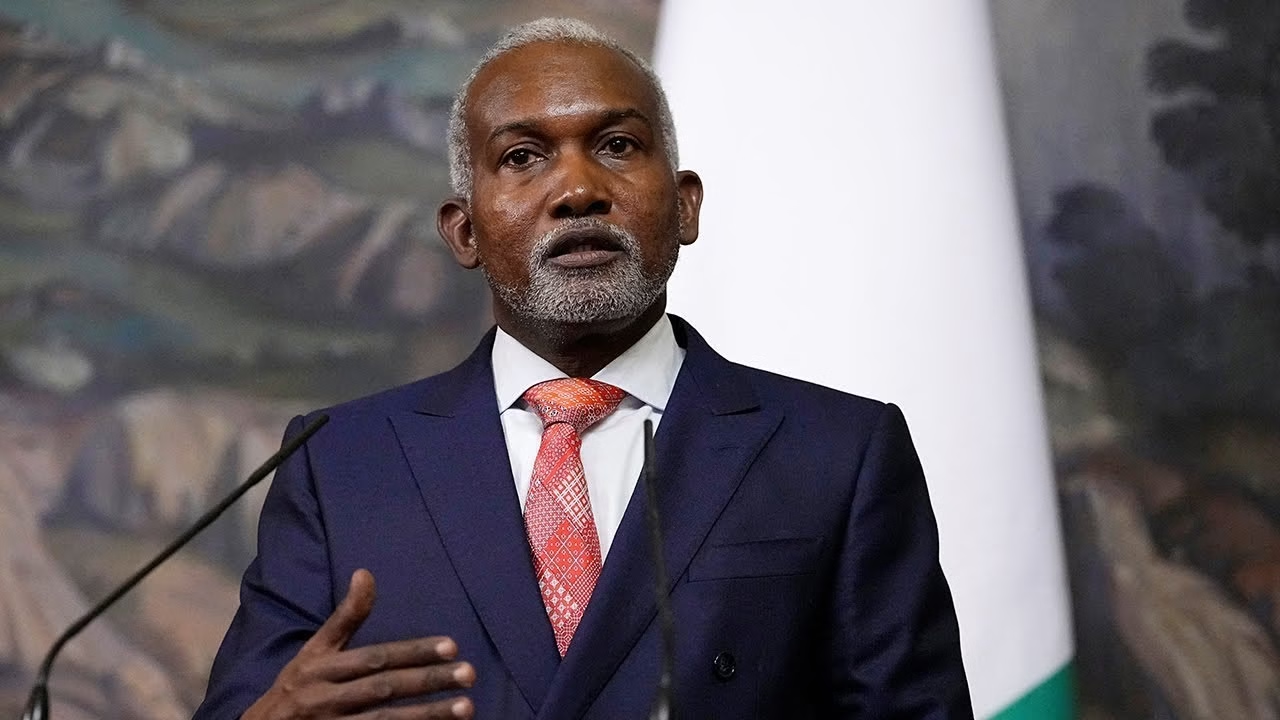
Ambassador Yusuf Tuggar resigned in March 2026 to pursue his political ambitions—specifically, to run for Governor of Bauchi State. Notably, he was the first serving Minister to openly declare such an intention. Without hesitation, he took the bull by the horns. Those who know him well would say that he has always harboured the ambition to govern Bauchi State.
For a man who achieved so much, with so little, and within such a short period as Minister of Foreign Affairs, it is difficult to determine whether he should have remained in office to consolidate his gains or move on to a new challenge. I will explore this question more fully in due course. In the meantime, I am eager to examine his tenure—his key accomplishments, and particularly what stood out.
These are my five top legacies of Ambassador Yusuf Tuggar’s time in office as Nigeria’s Minister of Foreign Affairs.
In the first part of this two-part series, I examine two major initiatives he led while in office: the West African Economic Summit (WAES) and the Regional Partnership for Democracy (RPD).
1. Hosting the West African Economic Summit (WAES)
Over the past three decades, very few Nigerian Ministers of Foreign Affairs have treated the economic future of the West African sub-region as central to Nigeria’s own success. This goes beyond merely allowing the bureaucracy to implement a pro-African agenda; it requires actively leading the conversation from an economic standpoint.
Ambassador Tuggar exemplified this approach. As Minister, he spearheaded the inaugural West African Economic Summit (WAES), positioning it as a flagship economic diplomacy initiative of the President Bola Tinubu administration. The maiden summit was held from June 20 to 21, 2025, in Abuja, Nigeria’s capital.
The WAES was particularly distinctive. It was conceived outside the formal framework of ECOWAS and driven directly by Nigeria’s Ministry of Foreign Affairs under Ambassador Tuggar’s leadership.
The summit featured a Presidential Roundtable and a CEO Forum. However, its most innovative component was the “Deal Room,” which facilitated direct B2B and B2G engagements between private sector actors and government entities.
More fundamentally, the WAES signalled a shift away from the region’s longstanding dependency mindset toward a more self-reliant economic philosophy—one anchored on intra-regional trade, production, and market-driven integration. Ambassador Tuggar framed the summit as a “homegrown African solution,” underscoring Nigeria’s intent to re-anchor West Africa’s economic reintegration on private-sector dynamism and real investment flows.
Through the WAES, Nigeria reaffirmed its position as the economic anchor of West Africa while strengthening regional alignment with the AfCFTA. Crucially, it also reinforced Nigeria’s credibility as a leader within the sub-region.
2. The Regional Partnership for Democracy (RPD)
Democracy in West Africa is under significant strain. Over the past five years, countries such as Guinea, Mali, Burkina Faso, Niger, and Guinea-Bissau have experienced democratic reversals through coups and military takeovers. In contrast, Nigeria has sustained nearly three decades of uninterrupted democratic governance and its attendant dividends.
Against this backdrop, Ambassador Tuggar advanced the view that Nigeria must position itself as a norm-setter in democratic renewal within the sub-region.
In November 2025, under his leadership, Nigeria signed a landmark Regional Partnership for Democracy (RPD) initiative with the United Nations Development Programme (UNDP). The initiative was subsequently endorsed by ECOWAS and launched on the sidelines of the African Union.
The RPD seeks to shift the region’s democratic focus beyond elections toward institutional resilience. It targets five core challenges: democratic backsliding, weak institutions, disinformation, the exclusion of youth and women, and the need for early warning mechanisms against unconstitutional changes of government.
This initiative aligns closely with Ambassador Tuggar’s 4D doctrine of Nigeria’s foreign policy, particularly its democracy pillar. Through the RPD platform, he consistently emphasised that democracy in Africa must be rooted in local values, legitimacy, and effective institutional delivery.
Indeed, any serious discourse on democracy in Africa inevitably returns to the need for homegrown models—rather than systems imposed externally without regard for local realities.
These two initiatives—the West African Economic Summit (WAES) and the Regional Partnership for Democracy (RPD)—represent two of the five defining legacies of Ambassador Yusuf Tuggar’s tenure as Minister of Foreign Affairs.
In the second part of this series, I will examine his efforts in advancing Nigeria’s interests with key global partners, including the United States, the United Kingdom, Germany, and countries in South America. I will also assess what I consider his most significant contribution to Nigeria’s foreign policy: the articulation of the 4D Doctrine.
Ambassador Tuggar has established himself as one of the most consequential Foreign Ministers in Nigeria’s history. He entered office with a clear and deliberate reformist mindset. Despite operating for a period without a full complement of ambassadors, he navigated a demanding landscape and delivered measurable impact—enhancing not only Nigeria’s global visibility but also its standing, respect, and influence in international affairs.
Eyimofe Amajuoritse is a journalist covering Nigeria’s foreign relations.