
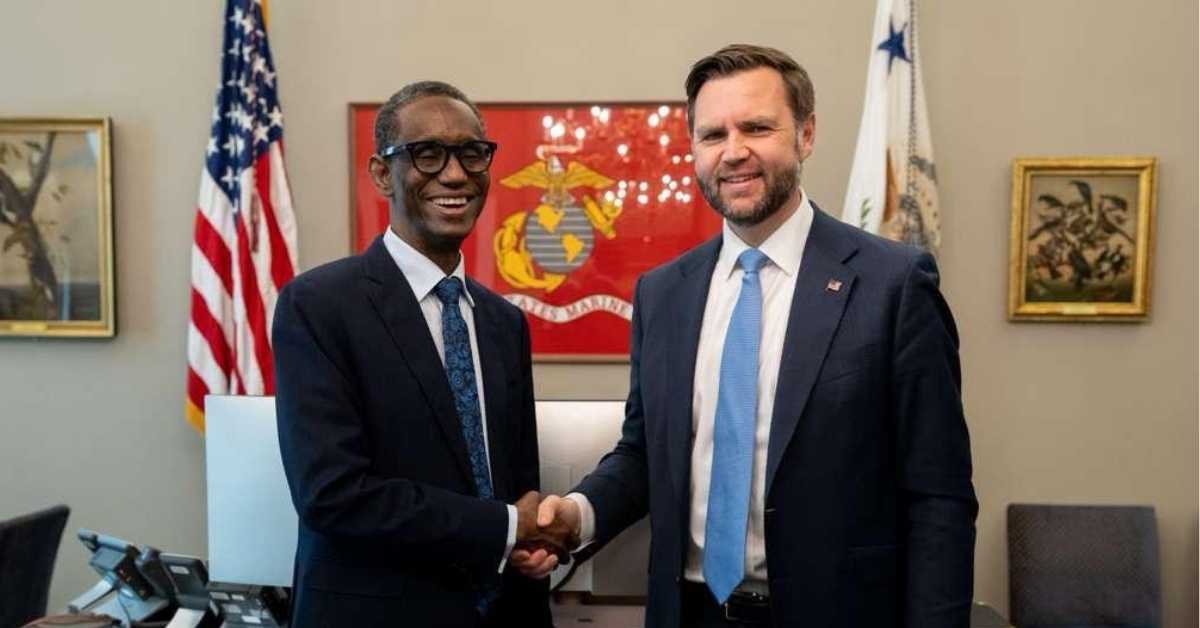
James David Vance is Donald Trump’s Vice President, and the 50th Vice President of the United States. Once a critic and now the most formidable ally of President Trump, Vance is a behind the scenes problem-solver and ideological voice for the President and his MAGA movement. He is one of the US President’s most consequential figures, with significant influence in the country’s foreign policy—and a strong potential for future leadership of the country.
Last week, Nigeria’s National Security Adviser, Mallam Nuhu Ribadu met with J.D. Vance at his
Residence, and then later with his counterpart, Marco Rubio who serves as both the Secretary of State and Acting National Security Adviser in the United States. This meeting, unannounced to the general viewing public did not come out of nowhere. It was the build-up of efforts of geopolitical diplomacy, negotiations, case-making and relationship building between the Nigerian and United States Government.
It started when the United States government, in October 2025, misled by irredentist lobbyists who got access to the White House, designated Nigeria as a Country of Particular Concern (CPC) under its International Religious Freedom Act, after a campaign by these lobbyists claimed that Nigeria was the newest victim of a genocide against its Christian population—who make up more than half of its people. That cooked-up tale found its way to the highest office in the US Government, Trump, and eventually began to form the basis of the government’s policy towards Nigeria.
President Bola Tinubu immediately rose to the occassion. He dispatched what many would describe as one of his most formidable assets, his National Security Adviser, Mallam Nuhu Ribadu to the United States to deal with the situation. And there the journey began. Within weeks, contact had been made; in late November 2025, Mal. Nuhu Ribadu led a high-level Nigerian delegation to the United States.
Mal. Ribadu held multiple meetings with key American institutions and officials. From members of the White House Faith Office, to officials of the State Department and the National Security Council, to the US Department of War, and crucially, the US Congress—where the mess had in fact first kicked off from.
The Ribadu-led delegation had a clear mission: to denounce that narrative of a genocide, or religious persecution, to stress that Nigeria’s security challenges affected everyone—Christian, Muslim and Pagan—and to seek a partnership with the United States that would help Nigeria fight these terrorist groups once and for all.
Mallam Ribadu, during that visit met with the U.S Secretary of War, Pete Hegseth—building a crucial and strong relationship the country needed to advance against terrorist and criminal groups.
By the time the Ribadu-delegation were back, the seeds were already bearing fruit from the visit. The two governments, the United States and Nigeria had agreed to establish a Joint Working Group that would present a united front to coordinate their countries’ security cooperation. On the Nigerian part, membership was drawn from senior officials from the defence, intelligence, foreign affairs, police, and humanitarian agencies.
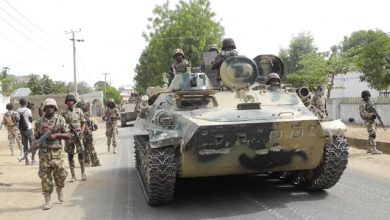
The tone from the United States had switched from dealing with an enemy, to partnering with a friend. By late December 2025, the US and Nigeria, through the United States Africa Command (AFRICOM) conducted airstrikes in Northwest Nigeria—precisely in some areas around Sokoto State—against positions associated with Islamic State militants and allied groups. This was possible through the strengthened relationship the two nations now enjoyed, and consequently through shared and actionable intelligence.
Since that time, the two countries have shared intelligence between their security apparatuses. The US Government has also delivered critical military supplies to Nigerian security agencies.
Mal. Ribadu’s meeting with Vice President J. D. Vance was not accidental. It was the build up of long weeks and months of strategic engagements, conversations behind-the-scenes, strengthened diplomatic relations, and a burgeoning friendship between the two countries. Their discussions centered around counterterrorism, intelligence sharing, defense collaboration, and regional stability in West Africa—particularly threats from Boko Haram, ISWAP and affiliate groups in the Sahel.
This visit, for Nigeria symbolized the point of high-level rest between it and the United States. It was a significant point in the deepening of Nigeria-U.S security cooperation. Nigeria will now receive more training and improved intelligence support from its U.S. counterparts, and a firmer resolve for a joint effort to dismantle terrorism in the country.
This hard-reset in Nigeria-U.S. relations has turned a once frictional relationship into a collaborative one—and the work is far from over. Vice President Vance is no casual personality in the U.S. Government; his door does not open for just any visitor. That Mal. Ribadu walked through it says everything about how far Nigeria has come—and signals, clearly, where it is headed.
Mohammed Abiodun is a historian, and writes from Abuja